Zero models
Raspberry Pi Zero offers an ultra-compact single-board computer (SBC) design with lower power consumption than our classic SBCs. These models omit some features found on classic Raspberry Pi SBCs to achieve a much smaller form factor that’s better suited for embedded and portable applications. All Zero models share a common hardware baseline, including:
-
A microSD card slot.
-
A mini HDMI port.
-
Two micro-USB ports, one for input power and one for external devices.
Since version 1.3 of the original Zero, all Zero models also include a mini 22-pin, 0.5 mm (fine) pitch, 11.5 mm width, CSI (camera) port.
The main differences between models within a generation of Raspberry Pi Zero depend on whether the board includes:
-
Wireless connectivity. Models with a W suffix include an on-board radio module for Wi-Fi and Bluetooth; models without the W suffix have no wireless capabilities and require a USB adapter for networking.
-
Pre-soldered GPIO headers. Models with the H suffix or the with headers label (depending on generation) come with pre-soldered 40-pin headers. Models without the suffix or label come with unpopulated holes; if you want GPIO access, you need to manually solder the header or install a compatible third-party pin kit.
Model list
Edit this on GitHub
The following table summarises Raspberry Pi Zero models in reverse chronological order, listing their key differentiating features for quick reference.
Raspberry Pi Zero models with wireless connectivity (indicated with the W suffix) come with:
-
2.4 GHz single-band 802.11n Wi-Fi (35 Mb/s).
-
Bluetooth 4.2 and Bluetooth Low Energy (BLE).
Raspberry Pi Zero 2 W specifies with headers instead of using the H suffix. Models that lack the H or the with headers suffix don’t come with pins attached to the GPIO header. For more information about each of these models, see the following dedicated sections on this page.
| Model | Microprocessor | Memory (RAM) | GPIO header | GPU | CPU |
|---|---|---|---|---|---|
Raspberry Pi Zero 2 W with headers (2021) |
Raspberry Pi RP3A0 |
512 MB of RAM |
40-pin GPIO header |
VideoCore IV |
1 GHz quad-core 64-bit Cortex-A53 |
Raspberry Pi Zero 2 W (2021) |
Raspberry Pi RP3A0 |
512 MB of RAM |
Unpopulated 40-pin GPIO header |
VideoCore IV |
1 GHz quad-core 64-bit Cortex-A53 |
Raspberry Pi Zero WH (2018) |
Broadcom BCM2835 |
512 MB of RAM |
40-pin GPIO header |
VideoCore IV |
1 GHz single-core 32-bit ARM11 |
Raspberry Pi Zero W (2017) |
Broadcom BCM2835 |
512 MB of RAM |
Unpopulated 40-pin GPIO header |
VideoCore IV |
1 GHz single-core 32-bit ARM11 |
Raspberry Pi Zero (2015/2016) |
Broadcom BCM2835 |
512 MB of RAM |
Unpopulated 40-pin GPIO header |
VideoCore IV |
1 GHz single-core 32-bit ARM11 |
Raspberry Pi Zero 2 W (with and without headers)
Edit this on GitHub
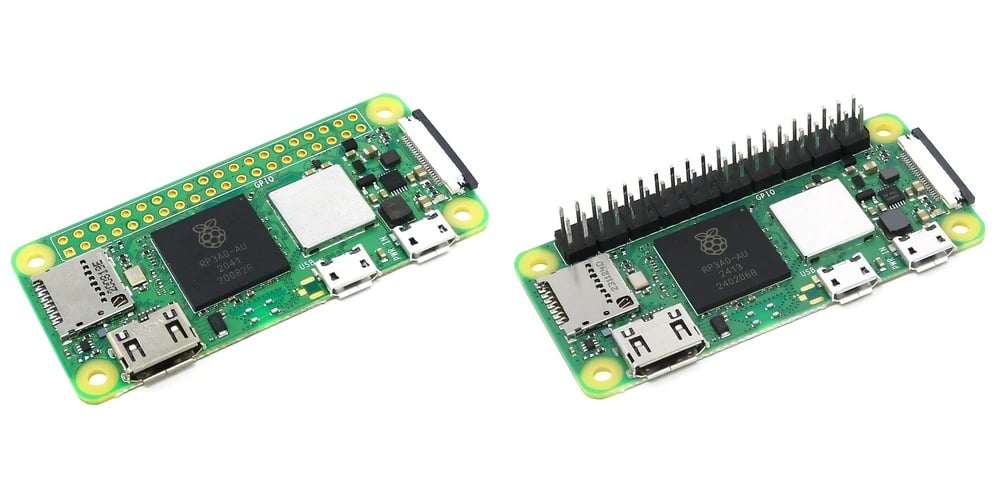
Raspberry Pi Zero 2 W comes with an unpopulated GPIO header; Raspberry Pi Zero 2 W with headers comes with a pre-soldered GPIO header. Like Raspberry Pi Zero W and WH, both models allow you to connect to a network over Wi-Fi.
The dimensions of a Raspberry Pi Zero 2 W (with and without headers) are approximately 65 mm × 30 mm. For more detailed measurements, see the mechanical drawing for Raspberry Pi Zero 2 W. For an engineering diagram of the electrical circuits, components, and pin connections, see the schematic drawings for Raspberry Pi Zero 2 W.
Feature changes from Raspberry Pi Zero W and WH
Raspberry Pi Zero 2 W (with and without headers) comes in the same form factor, with the same connectors and mounting holes, as Raspberry Pi Zero W and WH, but also introduces the following performance and connectivity improvements:
-
System-in-Package (SiP). The SoC and RAM are integrated into a single SiP, the RP3A0, which consists of:
-
A Broadcom BCM2710A1 SoC, with four 64-bit Arm Cortex-A53 CPU cores; each CPU core runs at 1 GHz.
-
A 400 MHz Broadcom VideoCore IV GPU for video and 3D rendering tasks.
-
512 MB of LPDDR2 RAM running at 450 MHz.
-
-
Faster processor. Replaces the single-core ARM11 processor on Raspberry Pi Zero with the quad-core 64-bit Cortex-A53 processor.
-
Upgraded Bluetooth. Upgrades wireless connectivity from Bluetooth 4.0 to Bluetooth 4.2.
The following sections describe these changes alongside:
-
Other internal components soldered onto a Raspberry Pi Zero 2 W.
-
The physical sockets and headers that allow you to connect external hardware to these components.
Raspberry Pi Zero 2 W (with and without headers) components
A Raspberry Pi Zero 2 W (with and without headers) includes the following on-board components:
| Component | Description |
|---|---|
SiP |
The SoC and RAM are included within the same component (SiP). The SiP is RP3A0, consisting of a Broadcom BCM2710A1 SoC, which includes a 1 GHz quad-core 64-bit Cortex-A53 (CPU) and 400 MHz VideoCore IV (GPU), along with 512 MB of LPDDR2 (enhanced low-power double data rate 2) RAM that runs at 450 MHz. |
Wireless module |
A radio module that acts as two components: a Wi-Fi radio for connecting to computer networks delivering single-band (2.4 GHz) 802.11b/g/n Wi-Fi; and a Bluetooth radio for connecting to peripherals, delivering Bluetooth 4.2 and Bluetooth Low Energy (BLE). |
Raspberry Pi Zero 2 W (with and without headers) ports
A Raspberry Pi Zero 2 W (with and without headers) includes the following ports:
| Port type | Raspberry Pi Zero 2 W | Raspberry Pi Zero 2 W with headers |
|---|---|---|
Micro USB ports |
Two micro USB ports, one port for input power, and one for USB On-The-Go (OTG), compatible with OTG adapters to connect keyboards, mice, USB hubs, and other external devices. |
|
Mini-HDMI port |
A mini-HDMI port, supporting a single display for video and audio output at up to 1080p at 60 Hz. |
|
CSI (camera) port |
A 2-lane MIPI Camera Serial Interface (CSI) port that allows you to connect to a camera. Implemented as a mini 22-pin, 0.5 mm (fine)-pitch, 11.5 mm-wide CSI port. |
|
GPIO header (unpopulated or populated) |
A standard 40-pin GPIO interface, arranged into two rows of 20. The GPIO header is unpopulated; after soldering on a 2 × 20, 2.54 mm pin header, its pins allow your Raspberry Pi Zero 2 W to talk to additional hardware (like LEDs, buttons, sensors, and so on). |
A standard 40-pin GPIO interface, arranged into two rows of 20, with a pre-soldered 2 x 20, 2.54 mm pin header. Its pins allow your Raspberry Pi Zero 2 W with headers to talk to additional hardware (like LEDs, buttons, sensors, and so on). |
MicroSD card slot |
A slot for a microSD card for loading an operating system and storing data. |
|
Test pad locations

Raspberry Pi Zero 2 W (with and without headers) has a number of test pad locations used during production of the board, listed in the following table.
| Label | Function | X (mm from origin) | Y (mm from origin) |
|---|---|---|---|
|
Power state of LED (LOW = ON) |
5.15 |
8.8 |
|
Processor power |
6.3 |
18.98 |
|
Connect to |
8.37 |
22.69 |
|
5 V input |
8.75 |
11.05 |
|
5 V input |
11.21 |
6.3 |
|
Ground pin |
10.9 |
3.69 |
|
Ground pin |
17.29 |
2.41 |
|
USB port |
22.55 |
1.92 |
|
USB port |
24.68 |
1.92 |
|
On-the-go ID pin |
39.9 |
7.42 |
|
1.8 V analog supply |
42.03 |
8.42 |
|
Composite TV out |
45.58 |
3.17 |
|
Ground pin |
49.38 |
3.05 |
|
Ground pin |
55.99 |
22.87 |
|
3.3 V I/O supply |
48.55 |
22.44 |
|
SD card clock pin |
60.95 |
18.45 |
|
SD card command pin |
58.2 |
16.42 |
|
SD data pin |
58.13 |
20.42 |
|
SD data pin |
60.65 |
21.1 |
|
SD data pin |
57.78 |
13.57 |
|
SD data pin |
60.8 |
15.22 |
|
Bluetooth power status |
25.13 |
19.55 |
|
Wireless LAN power status |
27.7 |
19.2 |
Raspberry Pi Zero W and WH
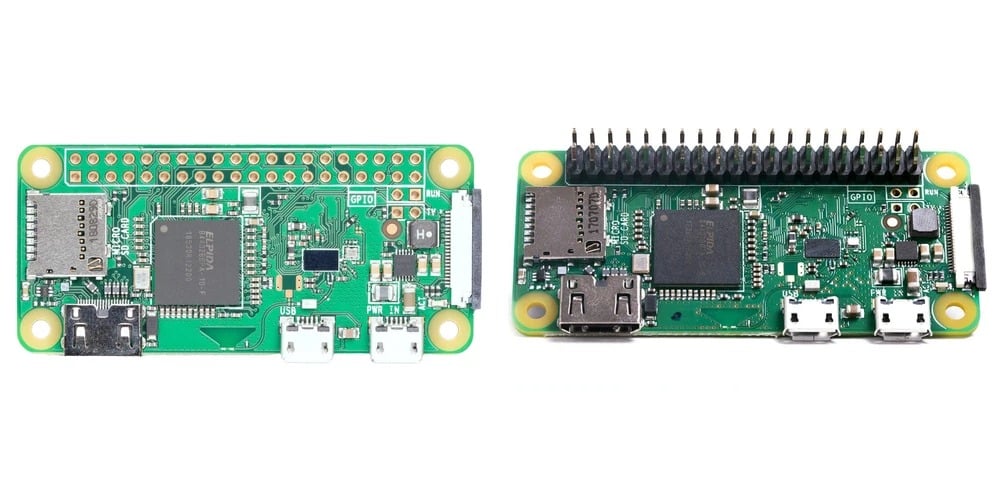
Raspberry Pi Zero W comes with an unpopulated GPIO header; Raspberry Pi Zero WH comes with a pre-soldered GPIO header. Neither model includes a wired Ethernet port, but you can still connect it to a network over Wi-Fi.
The dimensions of a Raspberry Pi Zero W and WH are approximately 65 mm × 30 mm. For more detailed measurements, see the mechanical drawing for Raspberry Pi Zero W. For an engineering diagram of the electrical circuits, components, and pin connections, see the schematic drawings for Raspberry Pi Zero W.
Feature changes from Raspberry Pi Zero
Raspberry Pi Zero W and WH come in the same form factor, with the same components, connectors, and mounting holes as Raspberry Pi Zero, but also includes wireless networking:
-
Single-band (2.4 GHz) 802.11b/g/n Wi-Fi.
-
Bluetooth 4.0 and Bluetooth Low Energy (BLE).
Additionally, Raspberry Pi Zero WH is the first zero model to offer pre-soldered GPIO headers.
The following sections describe these changes alongside:
-
Other internal components soldered onto a Raspberry Pi Zero W.
-
The physical sockets and headers that allow you to connect external hardware to these components.
Raspberry Pi Zero W and WH components
A Raspberry Pi Zero W and WH include the following on-board components:
| Component | Description |
|---|---|
SiP |
Broadcom BCM2835, which includes a 1 GHz single-core 32-bit ARM11 (CPU) and 400 MHz VideoCore IV (GPU). |
Memory |
512 MB of LPDDR2 (low-power double data rate 2) RAM that runs at 450 MHz. |
Wireless module |
A radio module that acts as two components: a Wi-Fi radio for connecting to computer networks delivering single-band (2.4 GHz) 802.11b/g/n Wi-Fi; and a Bluetooth radio for connecting to peripherals, delivering Bluetooth 4.0 and Bluetooth Low Energy (BLE). |
Raspberry Pi Zero W ports
A Raspberry Pi Zero W and WH includes the following ports:
| Port type | Raspberry Pi Zero W | Raspberry Pi Zero WH |
|---|---|---|
Micro USB ports |
Two micro USB ports, one port for input power, and one for USB on-the-go (OTG) port compatible with OTG adapters to connect keyboards, mice, USB hubs, and other external devices. |
|
Mini-HDMI port |
A mini-HDMI port, supporting a single display for video and audio output at up to 1080p at 60 Hz. |
|
CSI (camera) port |
A 2-lane MIPI Camera Serial Interface (CSI) port that allows you to connect to a camera. Implemented as a mini 22-pin, 0.5 (fine) mm-pitch, 11.5 mm-wide CSI port. |
|
GPIO header (unpopulated or populated) |
A standard 40-pin GPIO interface, arranged into two rows of 20. The GPIO header is unpopulated; after soldering on a 2 × 20, 2.54 mm pin header, its pins allow your Raspberry Pi Zero 2 W to talk to additional hardware (like LEDs, buttons, sensors, and so on). |
A standard 40-pin GPIO interface, arranged into two rows of 20, with a pre-soldered 2 x 20, 2.54 mm pin header. Its pins allow your Raspberry Pi Zero WH to talk to additional hardware (like LEDs, buttons, sensors, and so on). |
MicroSD card slot |
A slot for a microSD card for loading an operating system and storing data. |
|
Raspberry Pi Zero
Raspberry Pi Zero is a more compact version of classic Raspberry Pi models, with fewer connectors and an unpopulated GPIO header.
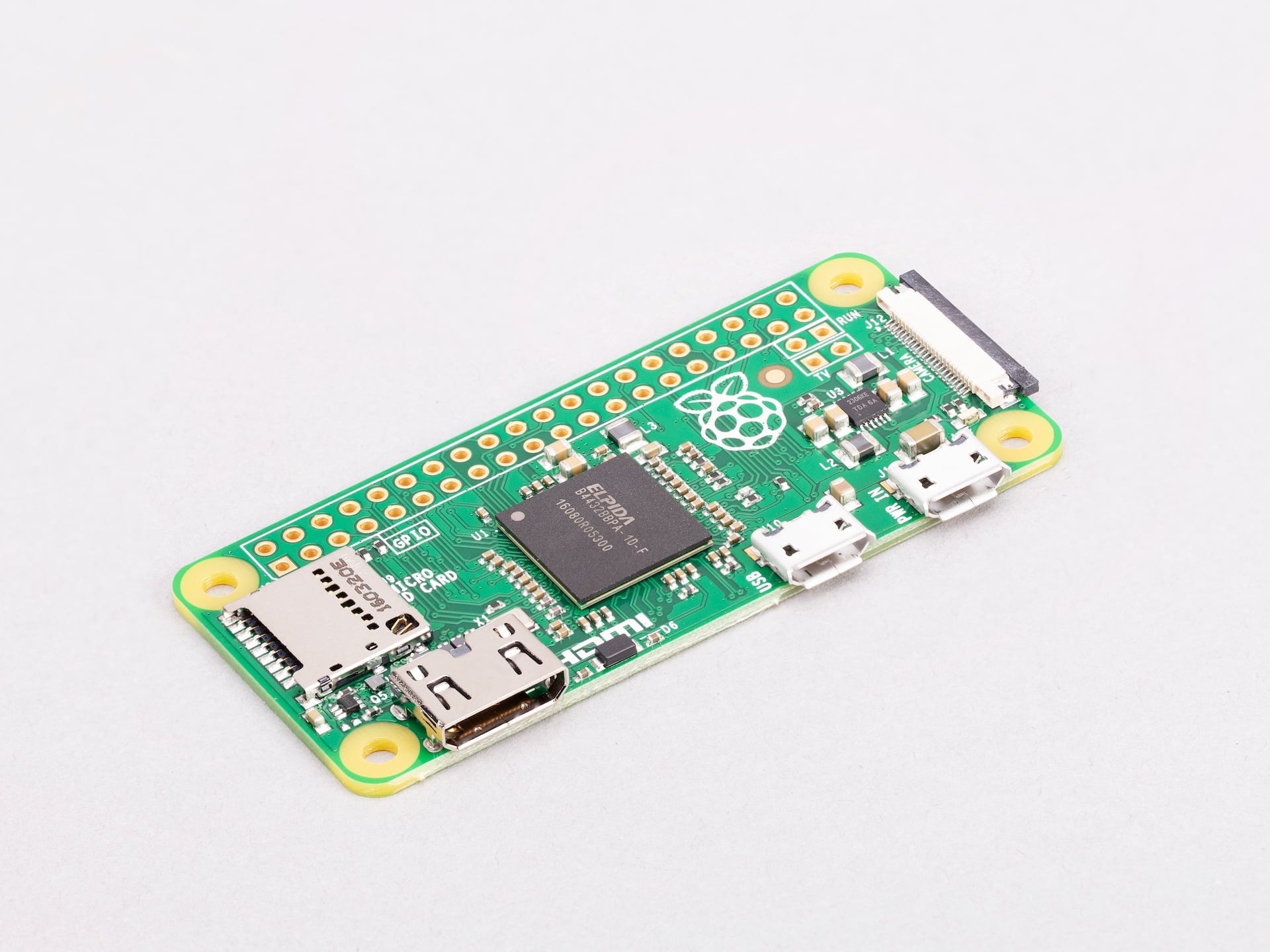
The dimensions of a Raspberry Pi Zero are approximately 65 mm × 30 mm. For more detailed measurements, see the mechanical drawing for Raspberry Pi Zero. For an engineering diagram of the electrical circuits, components, and pin connections, see the schematc drawings for Raspberry Pi Zero.
There are also a mechanical drawings for Raspberry Pi Zero cases:
Raspberry Pi Zero components
A Raspberry Pi Zero includes the following on-board components:
| Component | Description |
|---|---|
SoC |
Broadcom BCM2835, which includes a 1 GHz single-core 32-bit ARM11 (CPU) and 400 MHz VideoCore IV (GPU). |
Memory |
512 MB of LPDDR2 (low-power double data rate 2) RAM that runs at 450 MHz. |
Raspberry Pi Zero ports
A Raspberry Pi Zero includes the following ports:
| Port type | Raspberry Pi Zero W | Raspberry Pi Zero WH |
|---|---|---|
Micro USB ports |
Two micro USB ports, one port for input power, and one for USB on-the-go (OTG) port compatible with OTG adapters to connect keyboards, mice, USB hubs, and other external devices. |
|
Mini-HDMI port |
A mini-HDMI port, supporting a single display for video and audio output at up to 1080p at 60 Hz. |
|
CSI (camera) port |
A 2-lane MIPI Camera Serial Interface (CSI) port that allows you to connect to a camera. Implemented as a mini 22-pin, 0.5 (fine) mm-pitch, 11.5 mm-wide CSI port. |
|
GPIO header (unpopulated or populated) |
A standard 40-pin GPIO interface, arranged into two rows of 20. The GPIO header is unpopulated; after soldering on a 2 × 20, 2.54 mm pin header, its pins allow your Raspberry Pi Zero to talk to additional hardware (like LEDs, buttons, sensors, and so on). |
A standard 40-pin GPIO interface, arranged into two rows of 20, with a pre-soldered 2 x 20, 2.54 mm pin header. Its pins allow your Raspberry Pi Zero to talk to additional hardware (like LEDs, buttons, sensors, and so on). |
MicroSD card slot |
A slot for a microSD card for loading an operating system and storing data. |
|