Make a smart home
The dream of a smart home has been with humanity ever since The Jetsons aired in 1962. Lights that know when you walk in, thermostats that learn your schedule, speakers that answer to your every word…
And for a while it seemed that we were living in that future. Apart from the flying cars, we had smart speakers, voice assistants, clever lights, and homes warmed to Goldilocks levels of perfection.
What we increasingly had to think about was that every light bulb, smart plug, connected switch, and speaker is talking to the internet. They chat away to a range of companies, from small operations in China to massive US tech behemoths and everywhere in between.
In 2023, a House of Commons Committee report stated that 77% of UK adults own at least one smart home device, and that, on average, there are nine such devices in every UK home.
That’s a lot of chatter going to data centres. All of these devices phone home to analytics servers, send telemetry to manufacturers, and pass DNS queries through a variety of third-party infrastructure. Folks agree to all of this through T&Cs that they never read.
Privacy first
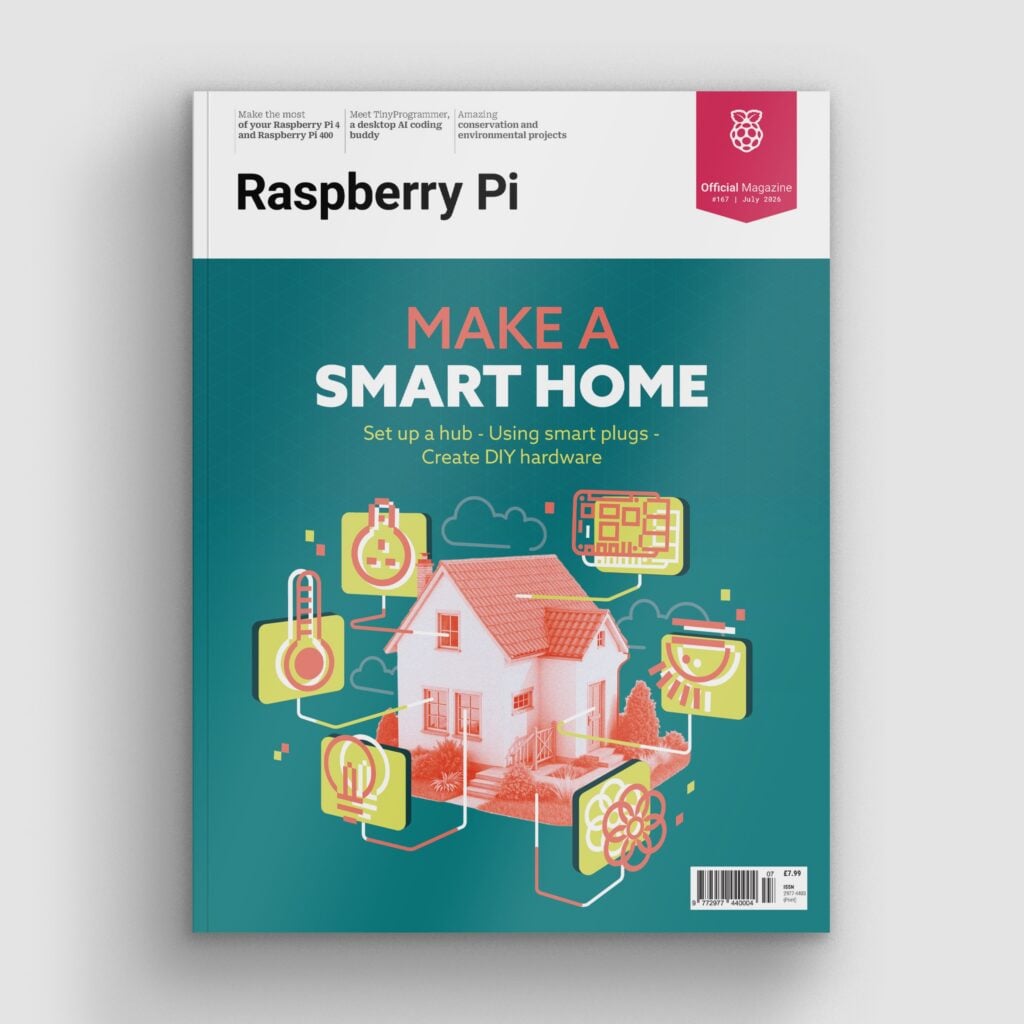
Running a Raspberry Pi is a great way to fix all of this mess; with Home Assistant, you can build a privacy-first smart home hub. In this month’s issue of Raspberry Pi Official Magazine, Ben Everard shows us his local smart home that keeps his data away from manufacturers’ floaty clouds.
It’s not just about tinfoil on the head, though. It’s much better to set up your own system and understand what’s going on inside your home. One of my favourite authors, Jeanette Winterson, said: “if you want to keep your own teeth, make your own sandwiches”. It’s important to know what’s going into a system if you want to stay digitally healthy.
What’s great about all of this — especially at the moment — is that you don’t really need a powerful Raspberry Pi 5 with 16GB of RAM to run a home network. In fact, an older Raspberry Pi 4 with a lot less RAM is perfectly powerful enough to manage your home.
We’ve also got a bunch of other projects in this issue that work on Raspberry Pi 4/400. Another privacy project that works really well on Raspberry Pi 4 is Pi-hole. I mention this because Raspberry Pi has been training a chatbot partially on our magazines, so I decided to do some digging into our analytics to find out what your favourite tutorials are — and it turns out that Pi-hole is really, really popular. So you can look forward to a refreshed tutorial on that in the near future. We do listen!
I hope that the AI data centre roll-out calms down soon, and that we can get devices at reasonable prices again. (I was hoping to buy a Steam Machine but suspect it’s going to be extravagantly expensive.) In the meantime, at least you can use low-cost Raspberry Pi computers to keep your personal information in a data store all of your own making.
Issue 167 of Raspberry Pi Official Magazine is out now!
If you liked this article, there are many more like it in the latest issue of Raspberry Pi Official Magazine. You can purchase a copy from the Raspberry Pi Store in Cambridge. It’s also available from our online store, which ships around the world. And you can get a digital version via our app on Android or iOS.
You can also subscribe to the print version of our magazine. Not only do we deliver worldwide, but those who sign up for a six- or twelve-month print subscription will receive a FREE Raspberry Pi Pico 2 W!





4 comments
Jump to the comment form
rclark
Glad to see hints of moving things ‘local’. A good thing. I’ve never had ‘any’ of the internet connected devices in my home for that very reason (I live in USA). And any home automation I do is created by me and on my home network (separate from internet network).
Wonder where the ‘smart’ comes from. It is just logic algorithms in the background… Sensor detects movement, light comes on. Nothing ‘smart’ about that :) . Seems must be just a marketing term… much like ‘AI’ is I suppose…. Something to fire the imagination, like the Jetsons for example.
Liam
Ditto the Steam Machine point. Was excited to order one, then saw that they cost nearly an entire month’s salary just for the basic model, and decided that it wasn’t worth it. Also, pretty glad I got my Pi 500+ just before the prices went up! Does beg the question whether this is prices going up due to demand, or due to supply issues.
rclark
Yeah, glad I got my 500+ (and all my RPI-5 boards) too before the price doubled as well. I have three RPI-5 SBC ‘spares’ in the wings waiting for projects, so not hurting there. Feel bad for those that need/want their first board. That said, I changed out the key caps on the 500+ for a more retro look and really like it. Fun little computer to play with! Might have bought a spare, but not now…
I’ve have a ’email notify me’ on getting a couple more Zero 2Ws for quite some time now, but still not in stock here in US at least. Quite capable little Linux computers in their own right.
Denis Lebel
I’m a retired tech/software guy and although I’m not doing home automation of purchased smart devices as in this post, I am using a PiPico with my own hardware to run a group of tradition wired devices with what I call a HomStat. My main heating control + summer mode blower, a humidifier, dehumidifier a Venmar air exchanger. I use an I2C bus via a ribbon cable that control 8 IO outputs, a multiplexer for several HTU21 temp/umid sensors. Lately I’m working on adding a IRFD transmit led to control a MiniSplit (heat pump) as I could not figure out how to simply turn it on/off with a single relay contact. The unit is nearby and its remote operates from the HomStat location so by reverse engineering I should be able to mimic its remote.