Turn text input into actions with Needle, a 14MB function-calling LLM
In this post, our friends from Cactus Compute show how Needle 2, a 14MB function-calling model, turns plain English into local actions on a Raspberry Pi 5, using the CPU alone. You can also check out Needle 3, freshly released.
Type “Turn the LED on” and 78 milliseconds later, the LED on our Raspberry Pi 5 comes on. That is Needle 2 running on the CPU alone – without a dedicated AI HAT.
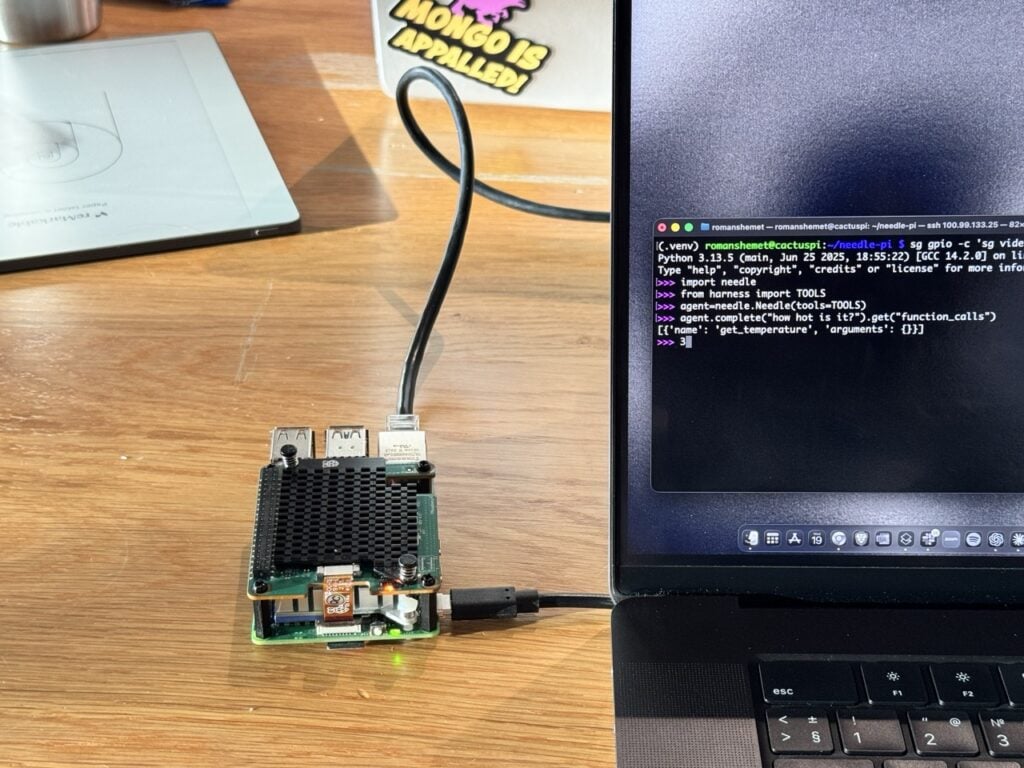
Let’s start with what Needle is not. It is not a chatbot. Instead, the team at Cactus Compute trained it for one task only: reliable, structured on-device actions.
“Needle 2 is rather excellent”
– Eben Upton, CEO, Raspberry Pi
The setup is simple – you declare Python functions, then Needle picks which one to call and fills in the arguments. We used it to write local notes, query vcgencmd, interact with the LEDs, and more on a CPU-only Raspberry Pi 5.
python3 -m venv needle-env

source needle-env/bin/activate

python -m pip install cactus-needle
After the first download, Needle runs locally without a cloud API or network connection. This first example needs no extra hardware.
import needle

from pathlib import Path

import subprocess

notes_path = Path("needle-notes.txt")
The Needle class accepts functions decorated with @needle.tool. The decorator uses each function’s name, docstring, and type annotations to build its tool schema. In save_note below, the annotation tells Needle that text must be a string.
@needle.tool

def save_note(text: str):

    """Append a note to a local text file."""

    with notes_path.open("a", encoding="utf-8") as notes:

        notes.write(text + "\n")

    return {"text": text, "path": str(notes_path)}

@needle.tool

def get_temperature():

    """Return the current CPU temperature of this Raspberry Pi in Celsius."""

    out = subprocess.check_output(["vcgencmd", "measure_temp"], text=True)

    return {"temperature_c": float(out.split("=")[1].split("'")[0])}

agent = needle.Needle(tools=[save_note, get_temperature])

response = agent.run("Save a note that says the cooler is working.")
Inside run(), the model first produces this tool selection (output trimmed for clarity):
{

  "type": "call",

  "function_calls": [

    {

      "name": "save_note",

      "arguments": { "text": "the cooler is working" }

    }

  ]

}
run() executes the function and includes its return value in response["results"]:
[

  {

    "text": "the cooler is working",

    "path": "needle-notes.txt"

  }

]
In this run, the initial complete() inside run() selected the function and produced its arguments in 107ms.
We can also ask:
agent.reset()

response = agent.run("How hot is this Raspberry Pi?")
Needle calls:
{

  "type": "call",

  "function_calls": [

    {"name": "get_temperature", "arguments": {}}

  ]

}
run() executes vcgencmd and includes the reading in its results:
{ "temperature_c": 49.9 }We also declared set_led(on), blink_led(times), and take_photo() via rpicam-still to test tool selection. Needle chooses the tool; ordinary Python code decides what happens next. You can similarly decorate any Python function that has a clear name, type annotations, and description with @needle.tool.
Needle is deliberately narrow. Ask “What is the capital of France?” and it returns { "function_calls": [] } in 92ms because none of the tools we gave it can answer that question. For an action model, refusing an unrelated request is the correct response.
Needle’s native session stays around 28MB. In this Python demo, the complete process peaked between 43MB and 46.4MB, including the interpreter. Here are a few more runs:
| Prompt | Call | Prefill (tok/s) | Decode (tok/s) | Time taken (ms) |
| Turn the LED on. | set_led | 488 | 296 | 78 |
| How hot is this Raspberry Pi? | get_temperature | 487 | 303 | 149 |
| Blink the LED 2 times. | blink_led | 475 | 314 | 83 |
| Take a photo. | take_photo | 461 | 248 | 76 |
| Save a note that says the cooler is working. | save_note | 475 | 305 | 107 |
| What is the capital of France? | (none) | 470 | 297 | 92 |
These examples were run on a Raspberry Pi 5, 8GB, Raspberry Pi OS, CPU only, cactus-needle 2.0.7. Prefill and decode are Needle’s session counters. Each latency in the Time taken column is wall-clock time for one complete() call, before the selected Python function runs.
If you already write GPIO Zero functions, you can decorate them and pass them in. The same goes for other application logic. Needle can also be fine-tuned locally on a laptop for a particular set of tools.
You’ll find the weights and code at huggingface.co/Cactus-Compute/needle2, github.com/cactus-compute/needle. Both are released under Apache 2.0.


7 comments
Jump to the comment form
Roman
Thank you for the feature! Excited to power on-device experiences with Raspberry Pi.
Looking forward to answering any questions down here
Charles Ross
This is beyond useful especially given that no special HAT is needed! Thank you so much for sharing.
DaiTengu
Is that my laptop? I have the same sticker in the same spot. YOU KNOW HOW I FEEL ABOUT STICKERS, CARL!
Randall
Someone smarter than me is going to have to get me from A to C here… I fail to see the utility of using an LLM to handle deterministic logic and the resulting functionality that is already dead simple and widely documented. Has the feel of a solution looking for a problem with some added bloat and an unnecessary layer of ambiguous abstraction.
Anders
The purpose is to turn the interface into relaxed plain language and having the model sort out what is being requested, rather than having to work with a strict API calling protocol.
Randall
But before any of that happens, you still have to explicitly introduce the function to the model in the code? I don’t know. There are some really exciting stepping stones and uses for LLMs in tight spaces, but this doesn’t feel like one of them.
crumble
If this system will be supported over a long time, you can now build voice controlled toy or houses. A smart home can be great for disabled people.
If you are disabled, you want something stable, you can trust for many years. It shall not break after the next update.