LesionIQ skin cancer diagnostic
Summer is now at its peak (in the Northern Hemisphere) but, while most of us enjoy basking in the sun, it comes with an inherent risk. The number of diagnoses of basal cell carcinoma, the most common skin cancer, continues to rise while cases of melanoma skin cancer – the most dangerous of them all – are reaching record highs. “According to The Skin Cancer Foundation, skin cancer is the most common cancer globally,” says scientist Tess Watt. “Despite this, if melanoma is detected and treated at an early stage, its five-year survival rate is 99%.”
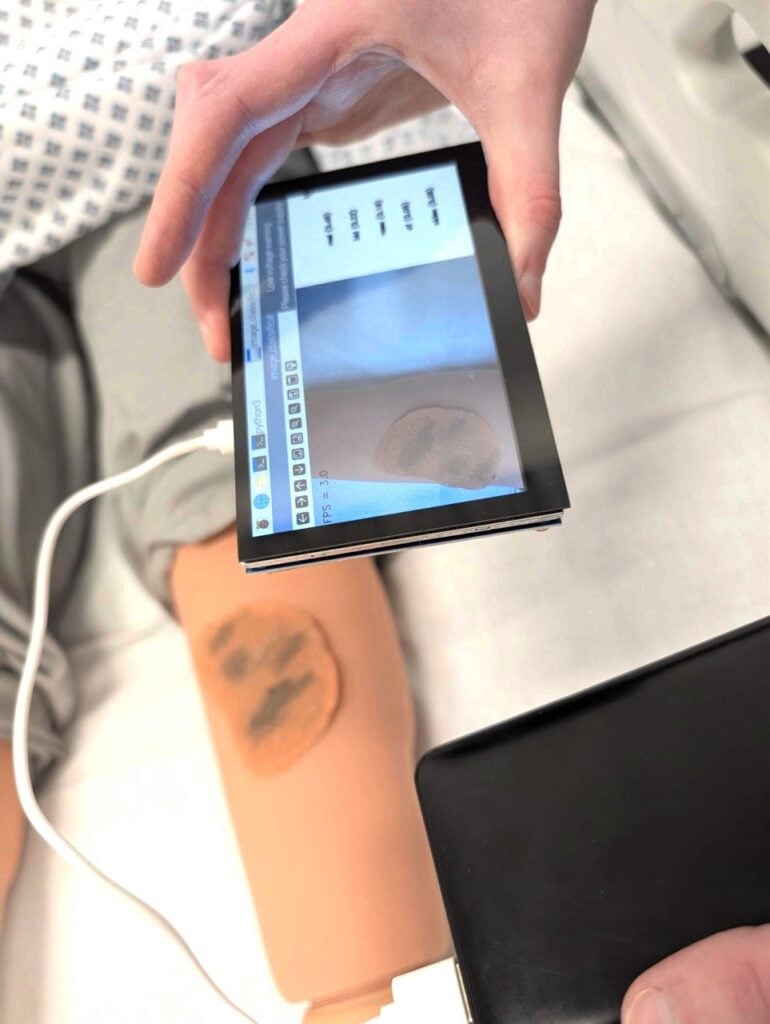
The system is a demonstration of TinyML – machine learning running on lower-powered, non-connected devices
With this in mind, Tess, a PhD candidate in the School of Mathematical and Computer Sciences at Heriot-Watt University in Edinburgh, has created an early detection system. She’s developed a set of AI tools designed to diagnose skin cancer and other skin conditions using a Raspberry Pi 3 Model B computer attached to a small camera. The aim has been to produce a low-cost device that can be used by patients living in remote areas of the world. It allows skin conditions to be monitored from home without the need for an internet connection.
Making a diagnosis
Tess’s system uses machine learning to analyse images of skin lesions. “Machine learning has overcome most of the challenges faced in traditional methods of skin lesion classification by analysing many images at once, more accurately than human dermatologists,” she says. “Machine learning can then identify patterns that the human eye cannot and can therefore be more accurate and objective.”
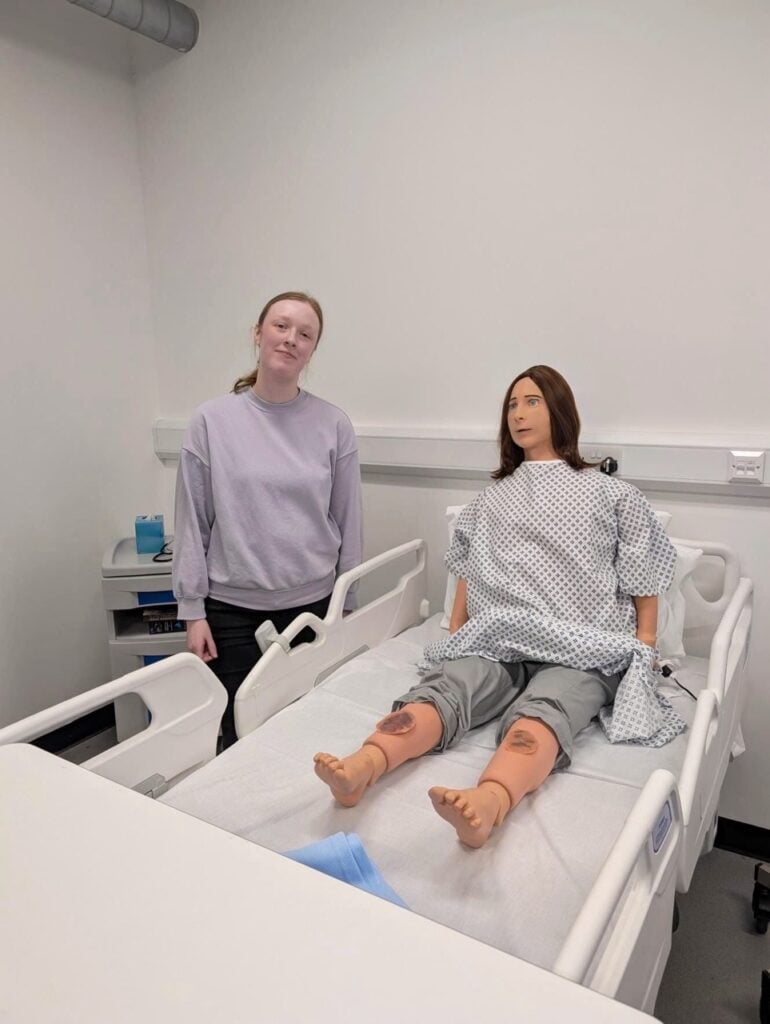
To assess a skin complaint, patients equipped with one of Tess’s devices would be asked to take a photograph of the affected area. Since the skin lesion image datasets are stored on the Raspberry Pi computer, her program is able to analyse the photograph in real-time before comparing it to thousands of images stored in the dataset. The idea is that the information would be shared with a GP and a decision made over potential treatment. “Current legislation [in the UK] requires a medical professional to validate the outputted diagnosis,” Tess says.
Global impact
Tess envisages LesionIQ being used in rural Scotland and she is in talks with NHS Scotland to gain ethical approval. But it could also become a vital tool for remote communities across the world, particularly given Raspberry Pi devices are so widely used and affordable. “I am often asked why I chose not to deploy my AI model on a smartphone, and this is because smartphones are costly and not widely available/used in developing countries where access to the Internet is also limited,” she explains.
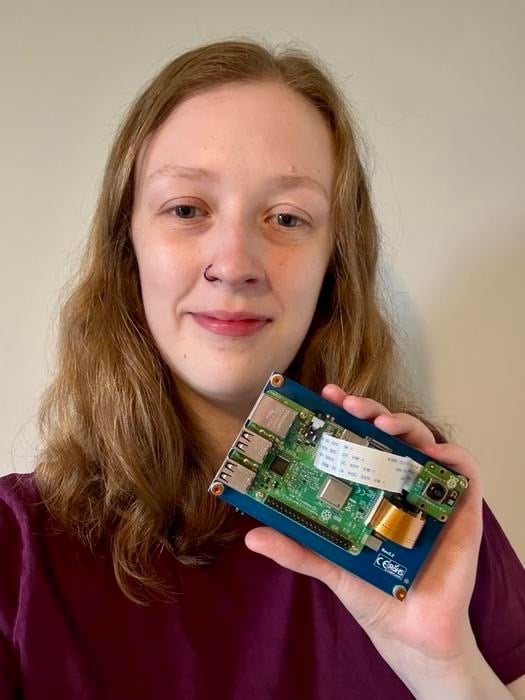
The device certainly looks promising. Currently, it’s proving to be 85% accurate in diagnosing skin cancer and Tess says this can be improved. “I am working with the small amount of publicly available skin lesion datasets available and I am working to create and access new datasets soon which are larger and more diverse,” she reveals. This is proving to be the greatest challenge, however.
“There is a lack of diverse skin lesion data available and the landscape of clinical AI is still in its infancy,” Tess adds. “My future plans are to create/source more diverse data and conduct a study to test this device in a real-world setting.” She hopes the device will be well on the path to being used by real-life patients before 2030.
Find more Raspberry Pi projects in Raspberry Pi Official Magazine
This article appears in issue 169 of Raspberry Pi Official Magazine, which you can access online. You can also subscribe to the print version of our magazine. Not only do we deliver worldwide, but those who sign up to the six- or twelve-month print subscription will receive a FREE Raspberry Pi Pico 2 W!
You can find Raspberry Pi Official Magazine on Facebook, X, Threads, LinkedIn, and Mastodon. You can also contact the team via email: [email protected]
6 comments
Jump to the comment form
cruble
Why (a Pi)?
I do not agree with the cost of a phone. You don’t need a new phone. A used one can be cheaper than a new Pi. The software can run local as well.
Better control of the sensor quality, near IR without OTG, less versions of the OS, … but hardware cost and off grid usability?
Tess Watt
Hi cruble,
Thanks for your comment. There are a couple of key reasons for using a Pi over a smartphone for this project.
1) The specific model of Pi used (Pi 3 model B) only costs around £35.
2) Security is vital when handling medical images. An offline Pi is more secure than a smartphone.
Of course, there is no ‘one-size fits all’ for different demographics, but for the remote areas this project is targeting, the Pi has been the most suitable device.
Hope that helps!
-Tess
crumble
Thanks for the quick reply. But I still disagree.
PIs are very good and cheap for prototyping. If you have to build a real product, chinese industrial computers are much cheaper.
Your 35$ are a Pi in a paper box. You need more stuff and time to build the whole system. A ready build phone or tablet is cheaper. Especially if it is not a single use device.
In your paper there shall be better reasons than 1/4 calculated cost. When you do not need special hardware, an existing software ecosystem, experiance with the development system or even “I had a spare Pi”.
When you have to defend your paper, half calculated cos is perfect amunition to build up some pressure.
gus3
“PIs are very good and cheap for prototyping.”
That’s true. And it was true 14 years ago, when Tess Watt was in primary school (my guess). The Pi was for testing ideas, affordably. And she doesn’t need anyone’s permission off the Internet to try it out.
“Tomorrow’s computers and peripherals won’t design themselves.”
https://mindplusplus.wordpress.com/2012/05/23/the-raspberry-pi-a-review/
Brian MacLeod
Tess should be congratulated. It’s a simple idea, her genius is in its application.
It could be the start of a trend. There’s lots of highly
expensive electronic medical equipment out there. How much of that could be done more cheaply using SBC like the Pi?
Even if it ends up as not as good as the existing products, it still means affordability in Third World countries where the highly priced perfection if First World equipment is the enemy of good enough.
crumble
Real medical products have to be certified. This process cost time and money, so the machines are expensive.
The result is a strange mix of security. They never get into a dangerous state. For example a pump will not give you a too high dose, because there was an int overflow. But if the network stack is part of the certification, it cannot be updated that easy. So black hats can set a deadly dose remote.