Learning with a homemade model insulin pump
This #MakerMonday we learn about a Raspberry Pi-based medical pump made by a diabetic teen who wanted to understand how insulin doses keep him alive. You can find more projects like this in the latest issue of Raspberry Pi Official Magazine.
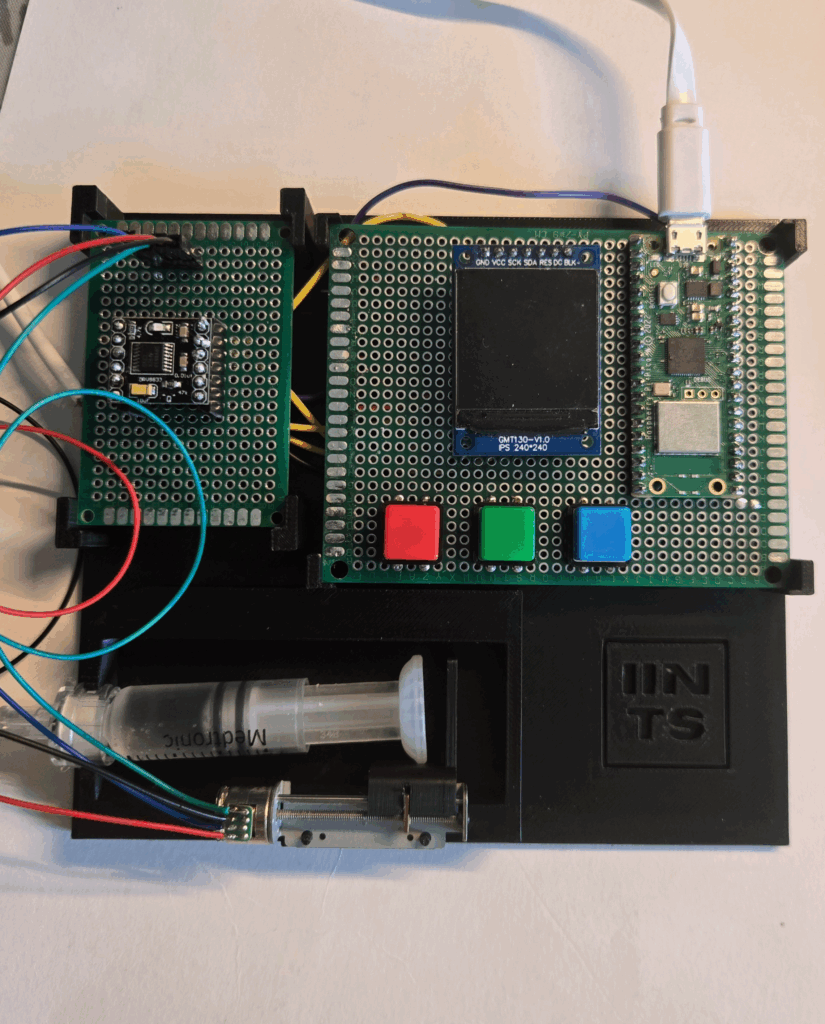
Teenager Rune Bobbaers was diagnosed with the auto-immune illness type 1 diabetes before he was old enough to start school. Curiosity about how insulin is used to manage his glucose levels and keep his body in check led Rune to investigate how to create his own dosage pump so he could understand how it operates. He was “immediately hooked” as soon as he began using Raspberry Pi 400. “That such a small, affordable computer could do so much really inspired me.” He worked on what would become his IINTS insulin pump project during CoderDojo sessions learning MicroPython and using Raspberry Pi Pico W. The now 16-year-old Rune submitted it as a Coolest Project, where it immediately caught the eye of the Raspberry Pi Foundation’s judges.
Mastering making
Rune was keen to design and build a fully open-source insulin pump from scratch having long “been fascinated by the medical technology that helps keep me alive, especially insulin pumps”. There was never an intention to produce a certified medical product. Instead he was after a personal learning experience as his curiosity gradually turned into a deep interest in technology and programming. Through his local CoderDojo group in Brussels, he’s had “the opportunity to turn ideas into real projects, ask questions, and get support from amazing coaches”. With a few Raspberry Pi builds under his belt, Rune credits the CoderDojo coaches’ support with giving him the confidence to tackle his first full project that combines hardware, software, mechanics, and medical tech all in one.
Rune set about recreating a pump simply and with affordable components. He chose to use MicroPython and Raspberry Pi Pico W because “it’s compact, affordable and powerful enough to handle everything from motor control and display updates to button input and background logic”.

The IINTS pump (the acronym means ‘insulin is not the solution’) can be used to manually select a dose using tactile buttons, with the amount shown on a small display. It can also calculate recommended doses based on a preset insulin-to-carbohydrate ratio. Once the dose is selected, a stepper motor controlled by Raspberry Pi Pico W pushes the plunger of a standard syringe and delivers the insulin. Impressively, Rune has even managed to add a feature whereby a background dose of insulin is continuously delivered, just like the prescription pump he uses to regulate his glucose levels.
Healthy approach
Rune began simply with a very basic breadboard setup that allowed him to test the screen, buttons, and motor together. Once this was working, he started designing and printing parts to hold the motor and syringe in place. “That’s when the real problems began: one of the early 3D-printed parts seemed slightly misaligned, so I mounted it on a metal lathe to try and fix it, only to later realise the issue wasn’t with the printed part at all, but with the stepper motor driver! Undeterred, Rune rewrote the code, simplifying large parts of it. He also had to redesign the enclosure, improving its durability and ergonomics as well as making it less bulky.

Rune has a sanguine approach to the iteration process. “Each version solved a problem from the previous one and, with every iteration, I learned something new about mechanics, electronics, and system integration,” he tells us.
“This insulin pump is the result of everything I’ve learned so far – and of my passion for understanding the devices that have such a big impact on my life.” He’s already planning the IINTS Mk II and would love to design a custom PCB to clean up the wiring, make the pump more compact and reliable, and make it easier for others to build their own version.
Anyone inspired to do so can check out his excellent video below.
Warning!
Do not use
This project is for educational purposes only. It is not a medically approved insulin pump and should not be used to administer insulin. Consult a medical professional for insulin administration advice.




11 comments
Izaak Raspberry
This is actually insanely impressive! The kid is a genius !
Rune Bobbaers
Thank you! xxx
beta-tester
Does it also read the blood sugar sensor without the help of the smartphone or sensor reader? what protocol does the sensor use?
Anders
I don’t think it uses any information from CGM monitors, even though there is a picture of one.
Rune Bobbaers
At the moment, my insulin pump doesn’t connect to any CGM (Continuous Glucose Monitor) so there’s no blood sugar sensor integration yet. I haven’t looked into that part in detail, since my focus has mainly been on getting the pump hardware and basic dosing logic working first.
I do know that Medtronic uses a closed protocol, which makes direct communication difficult without official documentation. Dexcom does offer a cloud API, which could make integration possible later on but right now, there’s no CGM or similar sensor support built into the project.
That could definitely be a next step, though!
Joe Quinn
Hey Rune – are you aware of the Tidepool project (https://www.tidepool.org/open) and Tidepool Loop (https://www.tidepool.org/tidepool-loop)?
Rune Bobbaers
Hey! No, I hadn’t really looked into Tidepool in detail before, but I just checked out the links it looks super impressive. Really cool to see how they’re working on more open and connected diabetes tech. My project is still very early and more about exploring how these systems work and showing what’s possible with open-source hardware. But seeing projects like Tidepool is definitely inspiring and shows the huge potential of community-driven innovation in diabetes care. Thanks a lot for sharing!
beta-tester
I’m wondering, is the CD/DVD/BR head stepper motor really strong enough to press a filled syringe?
Rune Bobbaers
Good question!
Right now, the little motor I’m using is just barely strong enough to push the cannula but only when the syringe is empty. Once there’s insulin or any resistance, it struggles quite a bit. So in its current state, it’s not strong enough for actual use.
The main goal of this prototype is to show how an insulin pump works. Real pumps barely move at all, so I wanted to make something where the movement is visible more like an educational model to help people understand the concept.
The pump already calculates doses pretty accurately, but the mechanical side is definitely something I’ll keep improving in future versions.
Let me know if you want to know more!
Jerry Wasinger
Very impressive, Rune. I have type 2 diabetes and wear a CGM so your project caught my eye.
Rune Bobbaers
Thank you very much 😊
It was very interested to learn more about tech we use everyday.
Comments are closed