Gugusse Roller transfers analogue film to digital with Raspberry Pi
This canny way to transfer analogue film to digital was greatly improved by using Raspberry Pi, as Rosie Hattersley discovered in issue 145 of The MagPi.
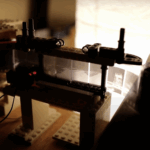
Gugusse is a French term meaning something ‘quite flimsy’, explains software engineer and photography fan Denis-Carl Robidoux. The word seemed apt to describe the 3D-printed project: a “flimsy and purely mechanical machine to transfer film.”

Image credit: Al Warner
Denis-Carl created Gugusse as a volunteer at the Montreal museum where his girlfriend works. He was “their usual pro bono volunteer guy for anything special with media, [and] they asked me if I could transfer some rolls of 16mm film to digital.” Dissatisfied with the resulting Gugusse Roller mechanism, he eventually decided to set about improving upon it with a little help from Raspberry Pi. Results from the Gugusse Roller’s digitisation process can be admired on YouTube.
New and improved
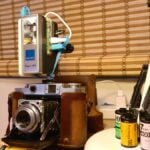
Denis-Carl brought decades of Linux coding (“since the era when you had to write your own device drivers to make your accessories to work with it”), and a career making drivers for jukeboxes and high-level automation scripts, to the digitisation conundrum. Raspberry Pi clearly offered potential: “Actually, there was no other way to get a picture of this quality at this price level for this DIY project.” However, the Raspberry Pi Camera Module v2 Denis-Carl originally used wasn’t ideal for the macro photography approach and alternative lenses involved in transferring film. The module design was geared up for a lens in close proximity to the camera sensor, and Bayer mosaics aligned for extremities of incoming light were at odds with his needs. “But then came Raspberry Pi HQ camera, which didn’t have the Bayer mosaic alignment issue and was a good 12Mp, enough to perform 4K scans.”

Image credit: Al Warner
Scene stealer
Denis-Carl always intended the newer Gugusse Roller design to be sprocketless, since this would allow it to scan any film format. This approach meant the device needed to be able to detect the film holes optically: “I managed this with an incoming light at 45 degrees and a light sensitive resistor placed at 45 degrees but in the opposite direction.” It was “a Eureka moment” when he finally made it work. Once the tension is set, the film scrolls smoothly past the HQ camera, which captures each frame as a DNG file once the system detects the controlling arms are correctly aligned and after an interval for any vibration to dissipate.

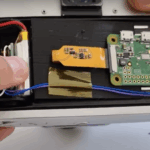
The Gugusse Roller uses Raspberry Pi 4 to control the HQ Camera, three stepper motors, and three GPIO inputs. So far it has scanned thousands of rolls of film, including trailers of classics such as Jaws, and other, lesser-known treasures. The idea has also caught the imagination of more than a dozen followers who have gone on to build their own Gugusse Roller using Denis-Carl’s instructions — check out other makers’ builds on Facebook.

4 comments
AndyD
What a fantastic project. Many years ago some else was capturing movies on film. I am impressed by the whole thought process that allows multiple film formats to be scanned.
Paul Hurm
I’m guessing this is not available commerciallly. Also, probably too expensive for me anyhow. But I have a lot of family film back to the 1930’s that I would love to convert!
Paul Hurm
Denis Carl Robidoux
The Gugusse Roller is a DIY project, all the instructions to build it are available for free online, no registration required. You print the parts yourself with almost any 3D printers, you buy the parts from the providers of your choice and you can get help from a Facebook group of enthousiasts.
It’s about the most affordable solution to transfer film to digital with this quality.
Riaan Vermeulen
Love these projects. I have a box of 16 and Super 16 mm reels my late father-in-law shot in the 70’s and 80’s. My aim is to digitise this at some point when I have time. Some of the reels have sound so my challenge is to capture the audio too and sync this afterwards with the stills.
Comments are closed