Raspberry Pi 500 and Raspberry Pi Monitor on sale now
Just in time for Christmas, we’re delighted to announce the release of two hotly anticipated products that we think will look great under the tree. One of them might even fit in a stocking if you push hard enough. Introducing Raspberry Pi 500, available now at $90, and the Raspberry Pi Monitor, on sale at $100: together, they’re your complete Raspberry Pi desktop setup.

Integral calculus
Our original mission at Raspberry Pi was to put affordable, programmable personal computers in the hands of young people all over the world. And while we’ve taken some detours along the way – becoming one of the world’s largest manufacturers of industrial and embedded computers – this mission remains at the heart of almost everything we do. It drives us to make lower-cost products like the $15 Raspberry Pi Zero 2 W, and more powerful products, like our flagship Raspberry Pi 5 SBC. These products provide just the essential processing element of a computer, which can be combined with the family television, and second-hand peripherals, to build a complete and cost-effective system.
But over time we have come to understand the benefits of integration: some people are better served by a system that is ready to use straight out of the box. This need was dramatized during the early days of the COVID pandemic, when we worked with the Raspberry Pi Foundation to deliver thousands of Raspberry Pi 4 Desktop Kits and monitors to young people studying from home in the UK. Our experiences with that programme informed the development of Raspberry Pi 400, our all-in-one PC, whose form factor (and name) harks back to the great 8-bit and 16-bit computers – the BBC Micro, Sinclair Spectrum, and Commodore Amiga – of the 1980s and 1990s.

Meet Raspberry Pi 500
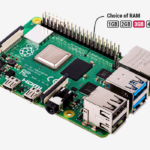
In the four years since it launched, Raspberry Pi 400 has become a hugely popular choice for enthusiasts and educators. And today, we’re launching its successor, Raspberry Pi 500, bringing the features and performance of the Raspberry Pi 5 platform to our all-in-one form factor:
- 2.4GHz quad-core 64-bit Arm Cortex-A76 processor
- 8GB LPDDR4X-4267 SDRAM
- VideoCore VII GPU, supporting OpenGL ES 3.1 and Vulkan 1.3
- Dual 4Kp60 HDMI® display output
- Dual-band 802.11ac Wi-Fi® and Bluetooth 5.0
- 2 × USB 3.0 ports, supporting simultaneous 5Gbps operation
- 1 × USB 2.0 port
- Gigabit Ethernet port
- Horizontal 40-pin Raspberry Pi GPIO connector


Raspberry Pi 500 is priced at $90, including a 32GB Raspberry Pi-branded SD card, and is also available in a $120 Desktop Kit, which adds:
- Raspberry Pi Mouse
- Raspberry Pi 27W USB-C Power Supply
- 2m micro HDMI to HDMI cable
- Raspberry Pi Beginner’s Guide, 5th Edition
The vision thing – an official Raspberry Pi Monitor
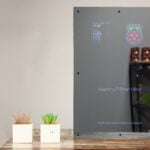
Although it’s highly integrated, Raspberry Pi 500 is only half the story: to build a complete system, you still need a display device. Which is why we’re also launching the Raspberry Pi Monitor, available now at $100. Designed to coordinate perfectly with your Raspberry Pi 500 or cased Raspberry Pi 5, it incorporates a 15.6″ full HD IPS panel with a 45% colour gamut and an 80° viewing angle, together with a pair of 1.2W speakers, in a slender enclosure with a fold-away integrated stand and VESA mounting points.

Power is provided via a USB-C connector. Cost-conscious users can power the monitor directly from their Raspberry Pi via the included USB-A to USB-C cable; in this mode display brightness is limited to 60% of maximum (still quite bright!) and volume to 50% of maximum (still quite loud!). Using a dedicated USB-C supply capable of delivering 5V/3A, like the Raspberry Pi 15W USB-C Power Supply, enables the full brightness and volume ranges.
Faster, better, cheaper: Raspberry Pi 400 price cuts
While we’re incredibly excited about Raspberry Pi 500, we need to remember that cost remains a barrier to access for many people, young and old. So we’re also taking this opportunity to cut the price of Raspberry Pi 400 from $70 to $60, and the Raspberry Pi 400 Personal Computer Kit from $100 to $80. We’re also bundling a Raspberry Pi-branded SD card with every Raspberry Pi 400, to help you get the best possible performance out of the system.

We know that quite a few of you have been eagerly awaiting both of our new products, and we hope you enjoy them now they’re here. We’ve seen Raspberry Pi 400 everywhere from retro gaming setups to university exam facilities and hospital offices; we’re really looking forward to finding out where Raspberry Pi 500 and our new Raspberry Pi Monitor end up.

172 comments
rpiMike
Great. Please make them in black.
Jamar
Nope, keep it white/red! It looks great and has best ergonomics (One can actually see the chars on the keycaps).
STX4
There can be both versions – white and black or dark gray.
horace
on a monitor a white bezel is not ergonomic and even mentioned in the EUs work space requirements laws.
Rijk
No, not in black.
All the common ordinary stuff is in black.
The Raspberry is not common, so keep it nice in white and red.
Lookin
Maybe there’s a reason why black is the default choice… White looks great maybe on over-lit advertising artwork, but in everyday use it’s mostly dirty and therefore ugly.
Raspberry Pi Staff Gordon Hollingworth
Actually, in general we sell more of the white/red Raspberry Pi cases, mice and keyboards than we do the black. So it’s not quite so clear cut. We will do both black/black and white/red (once we’ve got past the launch frenzy and can understand the volume requirements)
Joseph
Black is so 2010s. White is in.
Naveen
The Pi 500 and the Monitor look fantastic and very appealing!
Anders
Pretty disappointing omission.
Raspberry Pi Staff PhilE
Agreed – comments work better when the subject is clear.
Anders
That’s true being simplistic, but in this case you would have to be pretty detached to not know what this is about. And that is a statement in itself.
Jamie Whitehorn
You mean full-sized HDMI ports?
Helen McCall
Yes Jamie, He might be! But his comment might point to him having found that he can’t spin-dry his socks in the RPi 500, like we used to joke about with the big Winchesters in the 1960s and ’70s. Mind you, if you did try spin-drying your socks in the Winchester, you found the whole disk was left about as much use as the shredded socks that came out!
khaleel masri
Amazing products !
i will make the first order to our store in jordan now !
A Stevens
Brilliant news – we sensed it was coming, and now it has! We donated a stack of Pi 400s to my son’s primary school 3 years ago, and they’re still in regular use for a code club (that I used to run, before he moved up to big school). The biggest struggle they had was monitors, since they used ancient donated screens with VGA/DVI ports. Those HDMI adapter things proved very troublesome, and the Pi 400s just didn’t like those ancient screens. So I suspect the school may actually be more excited by the new monitor even than the Pi 500, for now, until they want to upgrade the computers as well!
kwh
I have a Pi 400, but it’s pretty limited, due to the lack of an NVME slot, so I haven’t used it as much as I was planning. Was really looking forward to the Pi 500, where I thought this was a no-brainer to include? Am I missing something?
Peter Green
Jeff geerling just did a teardown (on his “level 2 jeff) channel and it seems there is provision on the board for a M.2 slot, but the slot and it’s support components are not populated. He actually soldered down a M.2 connector but then realised that it wasn’t just the slot that needed populating.
I would assume this indicates that the plan to do a model with m.2 later, once the initial rush is cleared.
Tim Foley
Fully agree! Please make a model with M.2 and a cutout on the bottom to replace it.
fanoush
Sadly the slot on the PCB is not on the bottom.
kwh
Thanks, fingers crossed for an improved V2 for me, then.
mrlinux2u
Purchased the Pi 500 just now (early XMAS/Birthday present) – the missing m2 slot is a bit disappointing but hopefully they’ll be a future version with it included. It does mean I can use my existing Pi 5 for experiments (external AMD GPU for starters).
Alastair
Looks great.
Does this have the Pi5’s NVME connectivity lurking somewhere inside?
Rush
The lack of NVME support physically hurts to see- especially knowing the space for it is right there!
A Stevens
Yes, if you could attach an M.2 SSD to this, as with the Pi 5 and M.2 HAT, it would be a properly decent desktop PC for the majority of people. So close – maybe they should launch a 550 model at a slightly higher price point, with this capability!
ABrugsch
I’m suspecting a pi 500plus (à la Amiga 500 plus) will make an appearance with the extra parts populated. Expect it to be more expensive though (obvs)
Jim Bond
What does a Pi 500 have to do with an Amiga ?
barney
Eben is documented as being a fan of the Amiga
Anders
It’s great to have a fanless portable PI device available with a portable display that will allow for minimised cable spaghetti, it’s also good to see 8GB common sense. The price is also good if you consider that the SD card and keyboard are included it saves about £16 UK compared to a Pi5 /8.
But many of us are used to NVMe via PCIe performance now and it’s a bit of a setback to lose that. As the teardown review shows there are physical placeholders for more components this does feel like a rush to market for Christmas 2024.
Niallio
Is not aimed at us, though. It’s aimed at kids as a “my first computer” thing, and if they were to sell it with an NVME drive it would be more expensive and less appealing. And if they sold it with a slot and without a drive, that would make it only marginally more expensive, but would make it less appealing as a “fire-and-forget” toy, because most people would never use it.
The board as a unit might seem more expensive, but the describe if a penny they lose for the unused etchings is saved by the fact that they’ll be making a single board that can be either unpopulated (A500) or populated (the obviously planned A500+) and don’t need to maintain two production lines. This was common in analogue TV days — the only difference between a teletext and non-teletext set was whether there was a chip in a socket on the mainboard or not. The existence of the society may have looked wasteful, but it was just more efficient.
Personally I’d be waiting for an A500+, but I stingy suspect they’ll only be selling them with NVMEs with an operating system on them, and I’d personally want to throw an AI card on the NVME slot, so I don’t think I’ll bother….
Anders
Hi Niallio, the original Raspberry Pi and many of their products have found far more uses than what they were originally “aimed” at.
Paul
If it’s aimed at kids then why double the memory to 8GB, the Pi400 at a lower price would meet that need better and cheaper.
It could have been improved with a Nvme slot and drive, but it it ain’t – a bit of an odd decision there.
ABrugsch
Yay! Someone else who believes the “full” version will be the A500+ 🤞
AMIIIIGAAAAAAAAAAA!
W. H. Heydt
If an enhanced Pi-500 with NVMe support is released, I really do hope that it does NOT come with the drive installed. This is for two reasons. First, and foremost, no matter what size drive was included, many people will be unhappy. Either the price will be too high (if it’s a big drive) or there won’t be enough capacity to suit if a smaller drive is “standard”. Secondly, an upgraded Pi-500 without an installed drive can be used just like the current one, even if somewhat more expensive. One could even use it *with* an SSD for a while, and then remove the drive and revert to using SD card. (If you think that’s nuts, consider a scenario where you have a large drive with everything on it and a Pi-600 is launched that can take an NVMe SSD. Make sure the system is up to date and swap the drive to the new system and away you go. This would also cover the case of any other Pi-500 upgrades or failures.)
ThinkPad X61s
it was NOT aimed at kids. the pi 400 and 500 are aimed (mostly) towards newbies to raspi and those who just want to get stuff done. if you need a raspi aimed for kids, then get a Kano Computer Kit.
Helen McCall
Dear Anders,
This RPi 500 is clearly designed for a different set of users from the 5B. The RPi5 design has been nicely pared down to the absolute basics of a high performance, reliable basic computer. This keeps the price low for all those ordinary people who just need a basic computer for all the basic computing tasks made necessary by modern living. For those of us who want to do more adventurous things with our Raspberry Pis, we have the wonderful 5B and CM5 to choose from.
Anders
I agree it is selfish to make it all about my personal requirements, but it’s not just me.
The tangle free solution has been sought for a while and SD cards really are a technology of the past. M.2 NVMe is virtually as cheap GB for GB, whilst being more robust and better performing. It’s disadvantage is that it is less swappable.
As we all now know, the PCB has the placeholders to add M.2 device support over PCIe, just not populated. So there is more to this market than the single use case that you mention.
Helen McCall
Congratulations! This package addresses the modern need that most people have for a simple, inexpensive, reliable, basic computer to fulfill all the basic computing demands of shopping, homework, study, email, keeping up with the news and friends, etc. Keeping it all basic, without unnecessary frills, will make it so easy to use, and affordable, that I suspect this package will bring millions more people into the Raspberry Pi world.
Phil Atkin
Absolutely brilliant! Knocked it out of the park AGAIN.
Rick
Hmm…the unfinished/lack of nvme and still using micro hdmi is pretty disapointing and make the price increase a pretty hard pill to swallow.
Graycrow
It would be an immediate purchase for me if it had a populated M2 PCIe header for NVMe SSD. Now I would wait for a version with it if it ever comes out. I think it’s a bad decision not to include one and it will hurt sales.
xeny
re the lack of NVMe – I wonder if this is part of the reason for the command queue work on A2 SD cards. That’s gives a much better experience than a generic SD card at a lower incremental cost/easier swapping about than a NVMe board.
I’ve also just watched Jeff’s take apart video https://www.youtube.com/watch?v=omYWRb1dLA4 and that shows some level of provision on the circuitboard. Maybe there will be a Pi 510 with NVMe?
W. H. Heydt
Work on A2 command queuing probably has more to do with wringing every possible bit of performance out of SD cards. Similarly the work on NUMA to get the out of the available memory.
ellip
Great and awaited! ;-)
What about internationalized keyboard layouts!?
Still coming or not planed this time?
Raspberry Pi Staff Gordon Hollingworth
Yes they will be coming… We just have to begin with a smaller set of options
Andy K
I was excited to watch the review on Jeff Geerling’s channel, but that turned to dismay when it seems there are PCB tracks and places for a M.2 slot but it is left unpopulated. The RPi SSD Drives seemed like an odd decision at the time, but now make sense if they were due to find a home inside the Pi 500. Feels like this was rushed out for Christmas. Hoping this isn’t a post IPO trend for RPi.
Dave
Nice! Now can you make me a “pro” version with an SSD? Thanks :)
Ruben Martine Cabello
Logic says it may take some time, not much but some months.
1st reason: price. The oficial ssd pi hat+ IS 20$. Discounting 2$ of dollars for the PCB it’s still means 17$, total 117$, that goes above the 100$ magic price, so it makes sense for affordability reasons.
2nd reason: supply chain. They may have a decent supply chain for a small number of oficial hats. That is NOT the same that having a full chain for all the 500. They may be thinking of changing a few components or simplyfying them for final production.
3rd case:reusability. The metal sheet of the 400 and 500 it’s very similar, except for the M2 hole. It IS not geated to be removed, only user service replacing the keyboard for one with your language or if broken. The M2 hole IS also geated for servicing without removing the metal sheet: therefore a cut-out hole. That means not passive cooling for the M2, and having to find a way to limit power and heat on It. Not easy to do (debugging, compatibility tests, firmware, etc.) and may require extra components beyond the already planned in the board, and therefore a new board.
I, personally, would have only indented the sheet over the M2 socket, so once installed, the M2 would have pasively cooled too, and have to worry less about power issues. It would make changing It way harder, but still possible.
Also RP, the fundation, worked hard during the pandemic shortage so business that needed units to keep working and keep supply chains based on them viable. If that is also a posible reason, I will grin and bear that I can’t get the top version with all bells and whisthes on these Christmass and wait for the next one. Also, the teardown also shows it preconfigured to netboot without memory card, ideal for a school enviroment, where the cheaper price also helps lots. And my RP400, that works perfectly, it’s now even cheaper, so expanding an already existing setup it’s even easier. Kudos for them, really.
Well, enough arse-kissing, singing off.
Conjada
Maintaining the price point is obviously a major factor. I suspect it also has something to do with the fact that I just received my RPi 512gb ssd today, which has been preordered for a while. I would guess that there will be a “bigger” Pi 500 available in the future when production is ramped up and existing orders are filled for their own ssd’s. I also suspect that the SSD will be factory installed to negate the need to open a case that is bound to be damaged by many users. I would also guess that a 16gb ram version will also be available by then. Obviously, I don’t know…. Just a guess.
Harry Hardjono
As a traveler, I’m interested in external dimensions of these cool devices so I can get a case for them. My last unprotected laptop got spidered screen, unfortunately, so now I’m enclosing everything with hard/heavily padded cases!
W. H. Heydt
Pi Hut is advertising a heavy felt sleeve for the Pi-500. Looks like it may be the same one as has been sold for the Pi-400. I have a bunch with Pi-400s in them and they work fine.
Ben
Will these products be available at the Raspberry Pi retail store in Cambridge?
Raspberry Pi Staff Ashley Whittaker
They’re in store now!
Ray Allen
That monitor is what I was mainly waiting for after seeing it a few months ago. Ordered.
What a great Christmas resent for us… well me :)
aBUGSworstnightmare
well … was expecting to see M.2 slot (as indicated by the kernel sources) but sadly not there
Nader
I think we should be a bit more positive about these announcements!
The PCB is probably just a base that can be used for future products; we may see M.2 and PoE in future producta using this board. :)
Stephen
I think it’s fantastic that this comes with a passive cooling solution! I think the Pi 400 and 500 are awesome devices (I already have Pi 400)
But a pity there is not an all black version like the official wired keyboard they sell. The only other thing is the lack of NVME capability and an easily replaceable keyboard section (moving parts always go first). But those are minor things, I know they need to hit a certain price point and the white is very raspberry pi (but where’s the raspberry color :) )
Andreas
Will the Raspberry Pi 500 be available with Swedish and Finnish (SE-FI) region-specific keyboard layout for Sweden and Finland?
Andreas
Please consider alao making an expanded model with two M.2 slots for those wanting both NVMe and the Raspberry Pi AI Kit adapter for AI acceleration?
Helen McCall
Dear Andreas,
I wonder what the melting point of the case is? ;-)
Richard
I expect the lack of NVME is a cost thing. Different case needed plus the parts for the port. Could push the price above £100 and I am sure be more disappointed people if that was it’s price point than the ones disappointed with no NVME. Also if you were going to populate the NVME you would also populate the POE pushing price up more. I would not be surprised that there would be a thin client version targeted to industry for the future. 8GB of ram makes it booting from network possible. Ideal for call centres but would need to look more business like. Heavier more robust keyboard etc.
My random guess, a device, in black, with full size office style keyboard, POE and NVME sold at £190 + VAT. Targeted at think client market or small office admin system.
Markus
too bad it uses this micro HDMI conectors and has no internal mass memory. I wonder what reasoning is behind this
W. H. Heydt
You don’t consider an SD card to be “internal mass memory” (really should be “internal mass *storage*”? If not, what is it?
fanoush
ssd or emmc inside is internal storage, sd card accesible via slot from outside is removable storage, just like old harddisk vs floppy disk or cd/dvd
W. H. Heydt
An NVMe SSD mounted on an RPT M.2 HAT+ is also removable. Indeed, it may be somewhat easier to remove it than getting the SD card out of a Pi in some cases.
Liam
What keyboard layouts will be available in the future? I can only see US and U.K. ones, but need a Japanese layout – the Pi 400 was available with this after a while.
nafanz
I am very glad that you continue to expand your product line. But why did you abandon the signature red color on the keyboard (aka PC) and mouse? In my opinion, they look much better aesthetically. Please add a Russian keyboard layout to your models.
Nobby Nobbs
There is an alternative to individual SSD drives. NFS or SMB shared filesystems from a NAS server. Will we see a Raspberry Pi NAS server in the future – a Custard server perhaps?
Andrew Waite
Ugh! No return yet to full sized HDMI connectors.
MW
Like the 400 it is due to space available, see Jeff Geerling teardowns, you would not have needed to post this question like many have done over the last 4 years.
Sam
I hope you’ll forgive me but I don’t come to the same conclusion looking at the same pictures. There’s board space available next to the ethernet slot on one end, and where the WiFi chipset is on the other. Since PoE and NVMe aren’t populated anyway – there would be room to put full-size HDMI in here if the board didn’t have so much (currently) wasted space. :)
MW
Printed Circuit Board tracks also need to be accommodated within the footprint, it is not just a question of moving the connectors, hence why RPL have probably stuck to this design to offer 2 x HDMi ports.
Helen McCall
Yes MW,
You are very right about the PCB traces. There is another vital factor that a lot of those commenting here do not appear to have considered: The passive cooking system in the Pi 400 and 500 has a very tough job to keep everything cool stuffed into a plastic case like that. There needs to be a path for air to circulate efficiently for any cooling to work. So what appears to be empty space inside the case, will actually be vital to the proper functioning of the computer, and will have been carefully designed to provide the very best convection airflow.
Helen McCall
Whoops typo! “Passive cooking” should read “passive cooling”!
Andrew Waite
There are many other SBCs with full sized HDMI ports. As Chris Barnett says, good job there are two mini HDMI ports on the RPi4/5 as you can use the second connector when the first one breaks.
W. H. Heydt
Nitpick… The Pi4B/Pi-400/Pi5/Pi-500 have *micro*-HDMI connectors. It’s the Pi0/Pi0W/Pi02W that have *mini*-HDMI connectors.
David
I’d love to see a Raspberry Pi wireless keyboard and mouse. One dongle.
Helen McCall
Dear David,
If you really want a Raspberry Pi wireless keyboard, it is not difficult to convert the official Raspberry Pi keyboard into a wireless keyboard using a Pico W or Pico 2W to plug the keyboard into. Would make a fun little project for you.
Roary
You find that when you need to supply power to the Pico W over a longer period, it’s suddenly not so wireless.
Shifty
Off-topic, but I built a 7-seg clock based on a Pico W that connects to the internet daily and syncs the time. It’s been running continuously from a cheap no-brand 700mA power supply for around 8 months and I can see from the logs that it syncs daily without issue.
Raspberry Pi Staff Ashley Whittaker
I enjoy a good segue.
Sam
It’s not been your best year. The Pi 5 was a great release last year! So was the Camera v3. This year… The compute module is fine, but the IO board is a disappointment – a small increase in board size to fit standard ATX mounting (Like the old Via APC) would have been a killer feature. And now the 500 without the NVMe slot to make it a viable desktop-replacement makes it a hard sell for such an already limited (MIPI, normal HAT/shim support) learning tool. I know you’re working really hard, but this was a bit of a misstep that’s going to put a lot of people off evangelising this product. Here’s to seeing what you offer in 2025!
James Hughes
I think you might be the very first person to suggest an ATX compatible CM IO board. I suspect it would be too big, and therefore expensive. People want nice small devices on their desks while doing dev work, which is really what these are for.
Mr Raymond Whalley
Oh dear. The lack of nvme is a blow for me. I understand the need to keep the selling point low and that is fine for those who do not require large disk space for data/photo/video etc.. but not to provide the option for a P500 & P500 Pro (e.g.) at 2 price points is an own goal in my opinion. So no P500 under the Christmas tree for this Christmas, so fingers crossed a P500 Pro (or whatever they call it) will make an appearance for my birthday in March (please oh pretty please).
Helen McCall
Dear Mr Whalley.
You can easily have a large disk space with your Pi 500. The Western Digital Green SATA SSDs have about the lowest power requirements of any of them, and two of these could be fitted nicely to the two USB3 ports. The RPi 4B can drive two of these drives very nicely, so the RPi 500 should do even better with its improved power supply and independent USB3 ports. Just get a couple of those SATA to USB cables that Pi Hut sells.
rclark
I tested the RPI5 with a USB Samsung T7 1TB (as OS drive) and a WD 4TB HDD as the ‘data’ drive. Using the 27W power supply and the RPI5 ran great. Backed up 1.8TB to the HDD and no problems encountered — unlike the RPI4 that I tested back when. No need for a NVME drive ;) Ha!
Robin
Almost perfect….. Mildly annoying the HDMI ports are not full size …. BUT….
No M.2 is a deal breaker for me…. If/when someone figures out the components needed to add it I will buy one, but as it’s now I pass
BLMac
I’m another wanting the slot for onboard storage.
I’ve bought a Pi500 anyway, and hopefully the likes of Jeff Geerling will show us the way…
Otherwise I’ll simply wait until a +model comes out and buy that too.
Chi Man Wong
Is there an upgrade path from an existing Pi 400 to a Pi 500 with internally supported changes?
James Hughes
If you mean at a HW level, no. From a SW point of view, you can take a fully updated SD card from a Pi 400 and it will work in the Pi 500.
Chi Man Wong
Thank you.
microUSBlover
Really disappointing to this using USB-C rather than industry standard and field proven micro USB.
W. H. Heydt
Say, what? Most people are jumping the other way. From uUSB-B to USB-C.
You’ve got some ambiguity… Are you objecting the the USB-C power connector on the Pi-500? That is practically a given, since the Pi5 (and Pi-500) are using a PD PSU. Or are you objecting to USB-C for power on the display? There, I think it’s as much for consistency going forward as anything else. Pretty much everything that isn’t a one-off design seems to be moving the USB-C and PD for power connectors.
Helen McCall
Dear MicroUSBlover,
I am wondering if this might be an appropriate place to complain that the RPi 500 is totally incapable of spin drying my laundry? ;-)
microUSBlover
Dear Helen McCall,
yes, it almost certainly is.
pica200
Can you elaborate on the “45% colour gamut” point? Do you mean sRGB coverage?
X99
Why no M.2? This platform has so much potential!
Tom-K
Well, even though I’m generally enthusiastic about Raspberry Pis, this Pi500 (with monitor) is a typical “left-side-driver” development.
A stripped-down circuit board and a keyboard around it were developed, as well as a “cheap monitor to match” without any useful features.
I don’t want to complain, but in my opinion it would have made more sense to plant a full-fledged Pi5 in a (at least slightly better) touch monitor, and to make all of its interfaces accessible from the back or side.
The advantages would be obvious:
– The device could be used in a similar way to a tablet.
– Better for use in experimental environments, thanks to the touchscreen, you have less stuff lying around.
– An external keyboard is not absolutely necessary, and if you do, you can connect a full-fledged, country-specific one.
– No additional power supply would be required.
– All the cables would also not be necessary (there is already enough lying around on a lab table).
Steve
Sounds like you need the Pilet, which you may have seen in the RPi News a while back. I really hope it makes it into production. See https://www.raspberrypi.com/news/pilet-mini-pi-5-modular-computer/
Azure
Still no headphone jack? Seriously? That’s the entire reason I’ve been waiting on a 500, this is nuts. I remember reading once that the reason the 400 didn’t have it is because people would want it to be a combo mic jack, but I couldn’t care less about that. I just want to listen to audio in a way that isn’t inconvenient, and not having a headphone jack makes the 500 kind of useless to me. Same with the normal Pi 5, but cutting it there is at least understandable. In a larger device like this, though? Why?
Helen McCall
Dear Azure,
You will find the headphone jack socket at the back of the monitor, just above the USB-C power input. If you are using a different brand of desktop monitor with your RPi 500, you will find that most of them likewise have a headphone socket at the back or side. If you are using one of the rare monitors without a headphone socket, then you can find several simple shim-style soundcards made to fit the 400/500. Alternatively; if your headphones use BlueTooth, then just register them with your RPi 500.
Guillem Alsina
When will it be available with other national/language keymaps other than English?
Ron Alexander
Using an SD card is crazy. There better be room for full cooling and an SSD inside the case else NO SALE. There should be room inside the case for more expansion.
Adam
You can add me to the list waiting for nvme, seems like this was nothing more than a push for christmas profit.
Disappointed to see where the pi foundation has gone.
Anders
Foundation are not involved in the development of these devices Adam.
Stephen
Honestly the hundred series is where it’s at for me and I’ve been eagerly awaiting this upgrade.
Fortunately I was able to order a solus unit this morning and I’m looking forward to trying the Code The Classics series on it over Christmas.
Thanks everyone. It’s a slick upgrade!
Steve
Very disappointed with this. I’ve been hanging out for one of these for a particular project, but without the RTC (which I believe is not there) and the M.2 slot, it is not useful to me. I hope there will be enhanced versions with these features very soon.
W. H. Heydt
Unless the Pi-500 has a different PMIC than the Pi5 (and why would *that* be done?), the RTC is there. What’s missing at the moment appears to be a way to connect a battery to keep the RTC running when no power is present.
Personally, I’m not disappointed with the lack of an NVMe capability in the Pi-500. It’s what I was expecting for the launch. I expect a later (more expensive) version with that drive feature. I also hope that said follow-on version will also provide for a way to attach an RTC battery and tuck it inside the case. (I’ve been saying this for at least a year…so, as far as I’m concerned, the only surprise so far was the move to 8GB.)
Nick
On the Pi 500:
– I miss the red-white color scheme. Full white is dull and any dirt or scratches become more visible.
– The letter sizes on the keyboard are quite smaller compared to those on the previous products (those on Pi 400 and individual keyboard look much better).
– I love the programmable LED! :)
– No M.2 (heartbreaking) means I’ll wait for the Pi 600; hopefully with a slot for M.2 access, to avoid damage trying to pry the case open.
On the monitor:
– Awesome!
– I wish the speakers were replaceable with something a bit more powerful (3W would be nice).
– After watching Jeff’s monitor teardown, it would be nice to have a more serviceable assembly, or maybe instructions on how to take it apart without breaking it. My thinking is that replacing the speakers could be made easier – not sure how deep their wires go, and if they have connectors or soldered.
W. H. Heydt
If you want more powerful speakers with the monitor…there is the headphone jack.
rclark
Ordered a RPI500 today. I think I can find a use for it. Currently I have to have a keyboard, RPI5 and monitor available to just to get the initial user set up on an PI OS disk. Think that was a step backward, but that is just me. Used to just use ssh to setup user(s) directly. I digress. Anyway, this combines the keyboard and RPI5 so less space and cords needed. Stuff a wire-less mouse adapter into the USB 2.0 slot for one less wire too. Should be a handy ‘tool’ on the shelf when needed.
Pedro Mota
Will there be a Portuguese (PT-PT ISO layout) version of the PI500 ? Asking because there is such a Pi400 version
Ryan
Very exciting news! One question: Are the 500 and Monitor both made in the UK? Love these new options :)
James Hughes
Yes, both made in UK, and you can power the monitor from a Pi4 and Pi 4 power supply.
Ryan
Awesome, thanks for the info! Definitely going to have to buy them!
W. H. Heydt
I greatly fear that being made in the UK, and not in China, may make a major price difference in a very few months… So being made in the UK is positive news.
Ryan
sorry, one more question:
can the power supply of the 400 power the new Monitor?
I have a 400 and love it btw!
Andy Gale
This reminds me somewhat of the Amstrad CPC range!!
Paul S
There’s a growing need for a universal power supply, it’s nuts that we now have 14 different power supply units for a growing range of products and lets design a new one for the monitor, designing the RPI 500 and monitor to run at reduced power on one PSU seems like a step back.
DJ
“we now have 14 different power supply units”
I only see THREE listed at https://www.raspberrypi.com/products/power-supply/
(And that could easily be reduced to TWO, but people would grumble about having to spend an additional 3 usd for extra Watts they don’t need.)
Paul S
Oh yes, ha ha – I totally misread that drop down box and thought each product had its own. :-)
Hari Docherty
I like the Cheese grater in the back of the Monitor.
Helen McCall
Dear Hari,
Since they already offer Raspberry Pi Mugs and Coasters, I am wondering if this cheese grater means that soon they will launch the Raspberry Pi Sandwich Holder?
VAPINERO
I love England. You are amazing.
Gábor
How does the monitor handle resolutions that have different ratio (for example 4:3)? Does it stretch them to 16:9 or does it display them properly in 4:3 ratio with black bars on the sides?
Leo
I’ll pass, mainly because of lack of M.2. Here’s my wish list for the Pi 500+:
– M.2 slot
– Integrated trackpad (I don’t want to have to carry/plug a mouse/dongle)
W. H. Heydt
Gah. I truly *hate* trackpads. If a pointing device were to be added to the keyboard, make it a trackpoint. If the keyboard size is increased (which is what the trackpad you want would require), build it out with the rest of the keys (such as the numeric keypad) found on full-sized keyboards.
MW
Whilst it is great to see RPL launch new products, it is sad to have so much whinging about features. If RPL do not offer a product to match the end users requirements, then the end user should design and sell their own product.
There are many decisions that RPL have made which I disagree with but rather than being a one in a million unhappy person, I move on and find an alternative.
Helen McCall
Dear MW,
Well said! I am sure it will not take people long to realise that the new CM5 and official IO board actually make an ideal base from which to build your own modular 16″ laptop.
Bart Elffers
Hi MW,
I motion your statement. Although you might not always agree with the choices of RPL, I experience they make their choices well thought and they still stick to their initial mission after all the success they had over the years. But they also want to satisfy the more powerful users (in desires, needs and money), perhaps some time later, but they think ahead. Go on RPL!!!!! Yeah!!!!
Bart Elffers
Oops, twisted a proverb(?). It should be “I second your statement…” ;-)
Renny
It would be possible to add separate keycaps for Nordic countries. I feel it is lazy to have three letters on one keycap. Or add an option to buy keycaps.
MW
Hack the keyboard layout ?
https://www.jeffgeerling.com/blog/2024/raspberry-pi-500-uses-qmk-firmware-built-keyboard
Helen McCall
Also a good link for helping you build your own modular 16″ laptop. Just need to add tiny e-paper displays to the top of each key, and you could build a keyboard which automatically configures itself for any country or language.
Adrian
Nice upgrade to 8Gb memory. Pity the price tag is a bit more expensive in Australia.
MW
RPL products are sold in US Dollars worldwide, local taxes, shipping and currency exchange rates are not RPLs responsibility.
Helen McCall
Reading through all the comments here, I am amazed that none of them have complained that the monitor isn’t a 64″ touch screen running on clockwork!
W. H. Heydt
Well…. 64″ isn’t really “portable” and I–for one–don’t really care for touchscreen, especially in a desktop setup.
I do note that there have been hints dropped about possible larger displays in the future. Something in the 22″ to 24″ range could still be considered portable and I’d be delighted to see that happen. Especially if the resolution were cranked up to, say 2560×1440 at that size range.
Helen McCall
Dear W. H. Heydt,
I am seriously visually impaired, and so I like to be able to reduce the screen resolution to make everything easily readable. I use a 32″ monitor at 1920×1080, and a couple of Hannspree touchscreens, 24″ and 16″, at correspondingly lower resolutions. If I had this 15.6″ Raspberry Pi monitor, I would select the 720×480 resolution for comfortable reading. If Raspberry Pi do launch a 24″ version of this monitor, I would want to set it at about 1280×720. If this 15.6″ monitor had been launched before I bought the Hannspree 15.6″ touchscreen, I would have chosen this Raspberry Pi monitor instead.
W. H. Heydt
My sympathies on the vision issues. Part of the point to a bigger monitor is that you can always run it at LOWER than native resolution (or make other adjustments to make it usable). Perhaps I should add that I normally use a 27″ 1920×1080 monitor.
Mikael Bonnier
The version with the UK keyboard seems to be difficult to buy outside the UK since they only sell the US version here. I prefer the UK keyboard over the US. It’s easy to type Swedish characters on the UK keyboard layout using the default for UK in raspi-config. E.g. å is AltGr+Shift+[ A, ä is AltGr+[ A, É is AltGr+; Shift+E. Nordic keyboard layout seems to come in March, but I will stick to the UK. It seems Raspberry Pi has stopped having different keyboards for Denmark, Norway, and Finland/Sweden. You can also easily type Danish and Norwegian characters on the UK layout: æ is AltGr+A, Ø is AltGr+Shift+O. I think that is an advantage since I think all Nordic countries should switch to the Norwegian version and also use æ and ø since ǽ and ǿ then can be used.
MW
PiHut have an International Shopping option: https://thepihut.com
Mikael Bonnier
The customs is unpredictable and they not only add VAT but charge for charging VAT. If you buy it in Sweden or from EU you don’t have this problem.
benjamim
I love this. Thank you.
Helen McCall
Dear Benjamim,
Judging by the speed at which the 500 and the monitor sold out at the Pi Hut, I guess there are lots of people who love this. I hope you manage to get one quickly, to enjoy over Xmas.
Hussam Al-Hertani
I’m a big fan of Raspberry Pi products and have been buying them since 2012….still own the Raspberry Pi one. I think the Pi 500 is a great little device and the 8GB RAM update is welcome. I also understand why you chose to omit the M.2 connector/circuity. But given that I already have an RPi 5 with an M.2 Hat and use an M.2 drive, I don’t think I can go back to running an operating system from an SD card.
If you make a premium version of the Pi 500 with an M.2 slot and possibly a better quality (possibly mechanical) keyboard, I would seriously consider it.
Thank you for everything you do!
mrlinux2u
Just got my Pi 500 earlier today and I’ve got to say it’s a very nice (and nippy) computer indeed (overclocked to a stable 2.8GHz easily) :)
The keyboard feels nicer than the Pi 400 one did and it’s much better than my Chromebook keyboard for typing on.
The included microSD card comes with the 64bit version of Raspberry Pi OS (in case anyone was wondering) and is very responsive when launching Chromium etc.
It took around 10 minutes to plug it in,fully update the software and reboot – much more pleasant (and quicker) than other operating systems and all this running of a microSD card :)
All-in-all I (personally) love it and highly recommended it and it will be (with the aid of a 500GB SSD) my main desktop (replacing my current Pi 5) until there’s either a version with the m2 slot connected (500+/PRO) or the 16GB CM5 module is available.
Exaga
Any plans to produce it in a black (or other colour) livery Eben?
Helen McCall
Or maybe for those of us who learnt to program computers in the 60s, and wish to return to our hippy teens, a multicoloured psychedelic design. I would definitely be a customer for an official Raspberry Pi Laptop with a beautiful psychedelic colour scheme.
Raspberry Fields Forever! (to misquote The Beatles)
Gene M
Would have been nice to see some mounting points to screw a pi right onto the back..
MW
On ebay they sell VESA Mount Cases for RPI5, such as:
https://www.ebay.co.uk/itm/134812472602
Helen McCall
Dear Gene,
There are standard 100mm VESA mounting screw holes on the back of the monitor. If you do a search on Pi Hut for “vesa”, you will find a selection of standard VESA mounting plates for mounting either the raw Pi, or the Pi in a variety of different cases. According to the Monitor official documentation (https://www.raspberrypi.com/documentation/accessories/monitor.html); you will also need a set of spacers to allow egress of the cables.
Pip
Does it work with the raspberry pi 400 all in one company keyboard kit?
Pip
For context I’m asking about the monitor and the 400 kit not the 500 kit
Helen McCall
Dear Pip,
The HDMI should work with any Pi with HDMI. To power the monitor from the Pi, you will need a USB port able to provide 1.5 amps. The Pi 400 should be able to do that if you have nothing more than a mouse plugged in to USB, but might struggle a bit if you are powering several other devices from USB. Older Raspberry Pi’s will have difficulty powering the monitor from USB. The 3B has a total power budget of only 1.2amps across all four of its USB ports, and so would need a separate power supply for the monitor.
W. H. Heydt
The USB power budget for the Pi4B/Pi400 is also 1.2A. With the restriction to 60% backlight and 50% volume, one would suspect that the monitor probably would run on 1A.
Iftekhar Bhuiyan
The only thing that’s stopping me from getting one of this PC is the missing M.2 SSD slot. It would have been a great computer with some storage. Hopefully you guys would come up with a newer model soon enough. Thanks.
Laura Smith
Looking at these two fabulous things next to each other is making me imagine you’re all secretly working on a laptop for release this time next year. Tell me I’m not wrong. Oh wait, you can’t, it’s a secret… 😉
Helen McCall
Dear Laura,
It looks that way to me also. The motherboard looks like it is designed to fit a laptop case as well as the Pi 500. The unpopulated circuitry for NVME is in a position where one could not easily access it through the keyboard, but would be in the right position for an appropriately designed laptop case with a lidded section beside the keyboard. Then the large amount of unpopulated circuitry in the region of the power supply, looks like far too much to be just PoE circuitry, and far more likely to be laptop battery charging circuitry. And the wonderfully slim monitor with its very low power requirements would be ideal for a Raspberry Pi laptop.
Of course it is secret so they can’t say anything about it. But I’m thinking that it is time they had some women reviewers, and so they should note that you and I were bright enough to recognise the signs, and so send both of us the laptop to review! ;-)
rclark
Got an RPI500 in the mail this weekend. Even came with a SD card ready to go. Fired it up and no problems found. Just hooked up an HDMI monitor and a mouse and off an running. I think it will be a useful tool to have on the shelf when needing a keyboard and an RPI5…
Dieter Gerling
Hello!
This is great news.
When can we expect the release of the german(and other) keyboard layouts?
I have been using the Pi 400 as my daily sidecar since it was first marketed and cannot wait to put my hands on this new machine. :-)
Best regards and happy holidays to all of you!
Brian
I would like to give you my money for a version of this with an M.2 slot, a USB-C data port, and 16GB of RAM. Please let me give you my money!
Helen McCall
Dear Brian,
In the almost 60 years of my computing experience, I do not believe that I have seen any other computer system evolve anywhere near as quickly as the Raspberry Pi has. A dozen years ago, a friend gave me the original Raspberry Pi Model B with the 26 pin gpio. The difference between that really lovely little educational tool, and the latest Pi 5 models, is vast. I attribute this super fast evolution to the wonderfully skilled team of hardware and software engineers at Raspberry Pi Ltd. This amazing team has designed a superb basic affordable computer in the Pi 500. The motherboard does have an unpopulated area for an M2 interface, but this sits directly underneath the keys on the keyboard, and so there can be no way of easily and safely fitting an nvme ssd into a slot in that position. If you look at the pictures of the Pi 500s which have been torn apart by reviewers, you might notice that there is a lot of unpopulated space on the motherboard which looks like the space for battery charging circuitry. When you also look at the wonderful low power requirements and slim body of the monitor, you should be able to guess that the unpopulated space on the motherboard will be so that the same board can be utilised in a basic affordable laptop. Using common parts keeps the cost down, and helps make it affordable. All the signs are that this Pi 500 affordable computer desktop system will be joined by an affordable laptop system which might have provision for an nvme ssd, but I doubt it would have 16GB of RAM because that would push the price up. So if you want a Raspberry Pi with M.2 NVME, USB C, and 16GB of RAM; you should be looking at all the IO boards which are compatible with the Compute Module 5. Meanwhile the Raspberry Pi 500 remains as an outstandingly practical basic affordable computer which I would not hesitate to recommend to any of my friends who just want a basic computer for the necessities of life, and also to any school as an ideal educational computer.
Joel Cunningham
When is nmve going to be installed???
Helen McCall
Dear Joel,
If you really want a Pi 500 with NVME, here is an article on this blog, showing you how to build one yourself.
The article: https://www.raspberrypi.com/news/explaining-computers-beat-us-to-raspberry-pi-500/
David Homley
I’ll be getting one of these with the official monitor soon. My Pi 400 will be used just as a retro gaming computer, also with my new monitor.
It was a very pleasant surprise to learn of the Pi 500 and monitor’s release while reading a magazine tonight. The extra power of the 500 should largely eliminate the one problem with the 400 – that it is a little sluggish at times.
I don’t know why I did not consider a portable monitor before. It will be so much more convenient than reaching behind my primary monitor to unplug the Roku or whatever else I have plugged into the second HDMI port.
Shreshth
Does the Pi 500 use the “d0” stepping of the Pi 5’s BCM2712? I already have a 2GB variant of the Pi 5 that uses the same CPU and has made a great OMV NAS box. It would be nice to know if the same CPU is in this as I understand it has a lower power draw than the regular CPU (for running on USB power pack).
JOHN KENNEY
I have epilepsy bright colors along with white hurts, strangely enough and bother me. So please make dark colors charcoal, black, subtle looking please.
JMC Lab
We’re so near yet so far from perfection. Aside from the missing M.2 SSD, this thing should *absolutely* be using an all-in-one USB-C port (alt DP mode and PD 3.0), and the monitor should provide a USB-C PD power input and a single USB-C connector to connect to the pi. Just imagine how cleaner this would be, as well as allow connecting other devices. Given that, you could replace the 2 micro HDMI ports by a single full size HDMI for a secondary screen (or use it as a primary screen on a TV)
horace
got the monitor today. it’s really nice and i am very happy with it. :)
Raspberry Pi Staff Ashley Whittaker
Yay :-) is it in your home office or doing something more exotic?
horace
at the moment it’s a second monitor for my home office but later i plan to use it also for other things. for example a stop motion animation setup. :)
Comments are closed