Net zero at Pi Towers: how we’re doing it
With the buzzword ‘net zero’ falling from people’s mouths wherever you go — especially following what has been the hottest and driest summer on record — it feels as relevant as ever to share what we’re doing at Raspberry Pi. As businesses and individuals, we all have a responsibility to care for our planet, and here in Cambridge we’re trying to walk the walk, not just talk the talk.
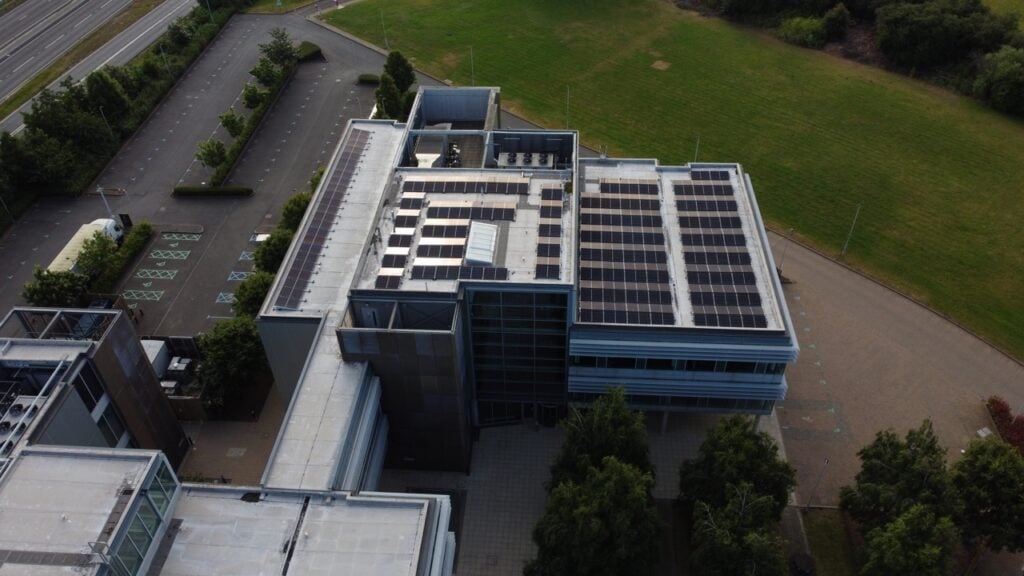
At Raspberry Pi Ltd, we’re seeking to be pioneers in transforming our property portfolio, ensuring we remain productive and supportive of growth whilst harnessing technology that moves us away from contributing to the carbon problem. Since our last blog post in 2025, where we set out four ambitions towards net zero, we’ve been on a journey to execute the plan. So, here’s a quick update on how things are going, what we aim to achieve this year, and what I hope to be able to report in the next post.
Our four ambitions were:
- To introduce solar PV and reduce our electricity consumption
- To introduce and encourage EV transport for staff
- To turn off the gas
- To reduce our electrical base load
Solar
Our 85.5kW array went live in June 2024, and has now generated 192,000kWh in just 26 months. Staggeringly, we’re on track to see a full return on investment in the very near future, at around 2.7 years.
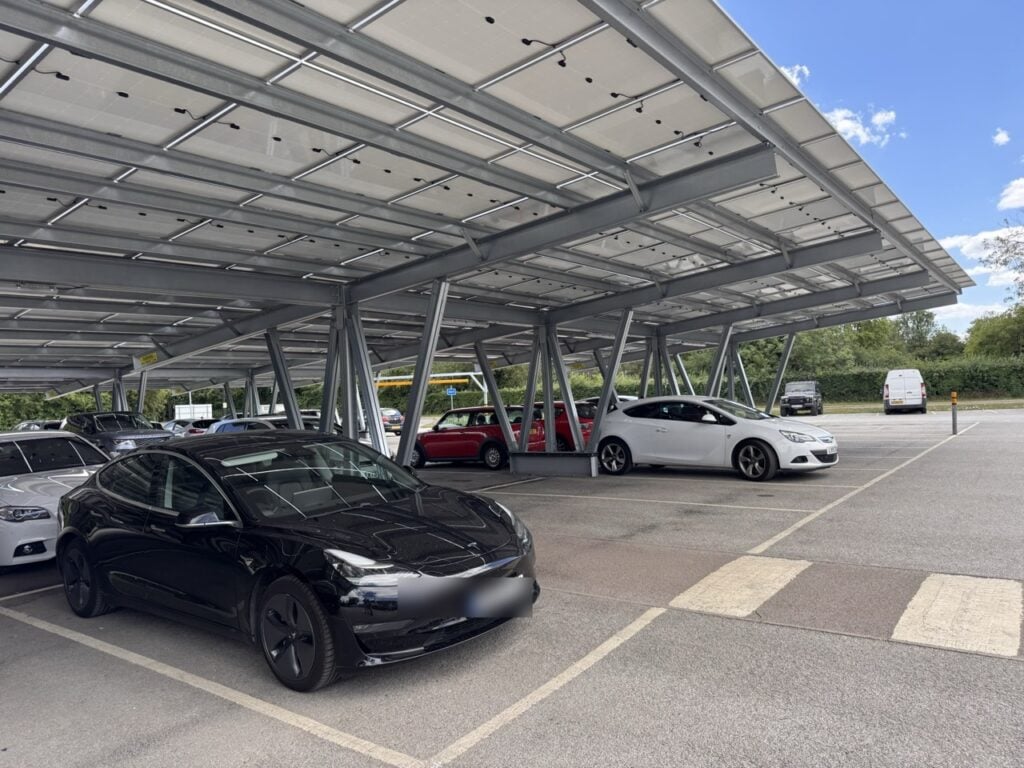
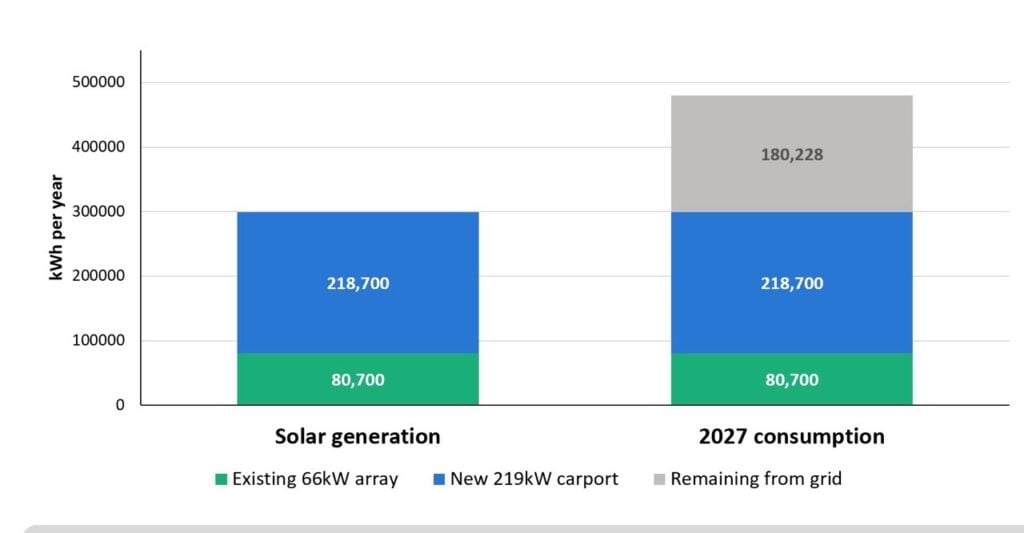
We’re using a lot of power, so we’ve set our sights on expanding the array at our Cambridge office with a 219kW solar carport system, with the support of our landlord’s agents, Stanhope. This will give us a combined array of 304kW across the site — enough to cover a whopping 63% of our predicted summer electricity demand.
“But what about the shortfall?” I can already hear you thinking. We’re delighted to have partnered with Granular Energy, an up-and-coming provider, to procure 100% renewable energy, ensuring the remaining Scope 2 emissions are offset with enhanced certificate traceability.
EV chargers
We installed 24 Easee chargers back in August 2024, and have since introduced a new salary-sacrifice EV scheme. When we last wrote about this, there were 11 EVs in the car park; we’ve now issued nearly 60 passes to staff and, at the time of writing, there are 20 cars charging. A second bank of 24 chargers is now planned in order to keep pace with this uptake. We want all staff and visitors to be able to charge quickly and with ease.
Attacking the base load
The further we go on this journey, the more we’re enjoying harnessing the capability of our own Raspberry Pi products to help us achieve our aims.
We quickly realised that electrifying a building doesn’t automatically help to reduce the base load. Using Raspberry Pi 4 and 5, along with open source Home Assistant software and Emporia clamping technology, we’ve been able to clamp every breaker in the building, as well as the main high-level supplies. This has enabled us to create detailed snapshots of the flow of every kWh we’re consuming.
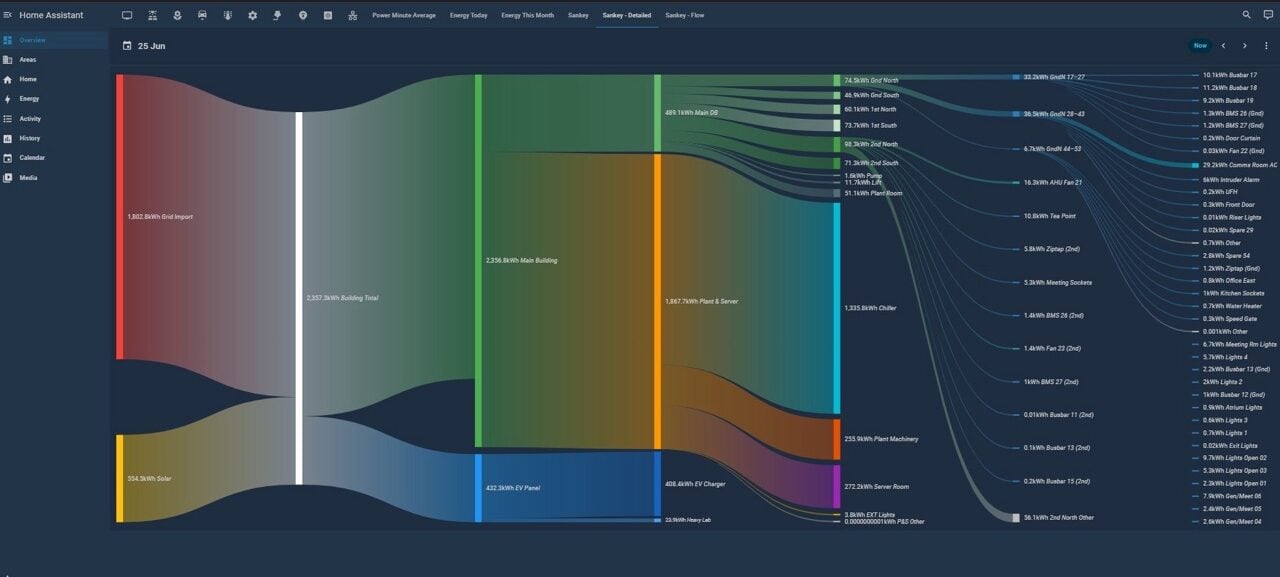
Some quick wins were possible, such as turning off certain lighting circuits we didn’t need and automating some other equipment. But in the main, we’ve recognised that the building needs significant power to keep running at the desired output — so we’ve sought to get creative when it comes to how. This is where things get interesting.
The key to success in this field is getting your hands on the data, being able to analyse it, and in doing so, gaining better control. Our old Trend 963 BMS interface failed in early 2026. It was 17 years old and proprietary, and a like-for-like replacement would have cost six figures. Instead, and with the support of our building engineering team, we chose Contemporary Controls’ BASview and BASpi — an open source BACnet system built on Raspberry Pi hardware. It provides weather compensation, CO₂-based ventilation control, solar integration, and much more granular visibility of temperature, air quality, and energy data, allowing us to enter a new phase of optimisation.
Old BMS replacement (like-for-like): ~£150,000
Our Raspberry Pi–based solution: £7,800
Turning off the gas
On 25 June 2026, we stopped using gas entirely at Pi Towers. Our two Potterton boilers were switched off, and we’ve since been maintaining a consistent temperature and delivering hot water without them. The hot water heat pump — which became operational in late 2025 — has taken over domestic hot water entirely, and will also power some of the underfloor heating demand.
25 June 2026: gas switched off at our Cambridge office.
July and August 2026: the first fully gas-free months on record.
Although we’ve enjoyed this brief period of Scope 1 net zero, as temperatures start to drop, we will need to switch the boilers back on to heat the building again. We could simply strip out the boilers and much of the plant to install a new all-electric system, but we’re keen not to waste or throw things away, prefering to adapt and slowly but surely turn off the gas entirely, all year round.
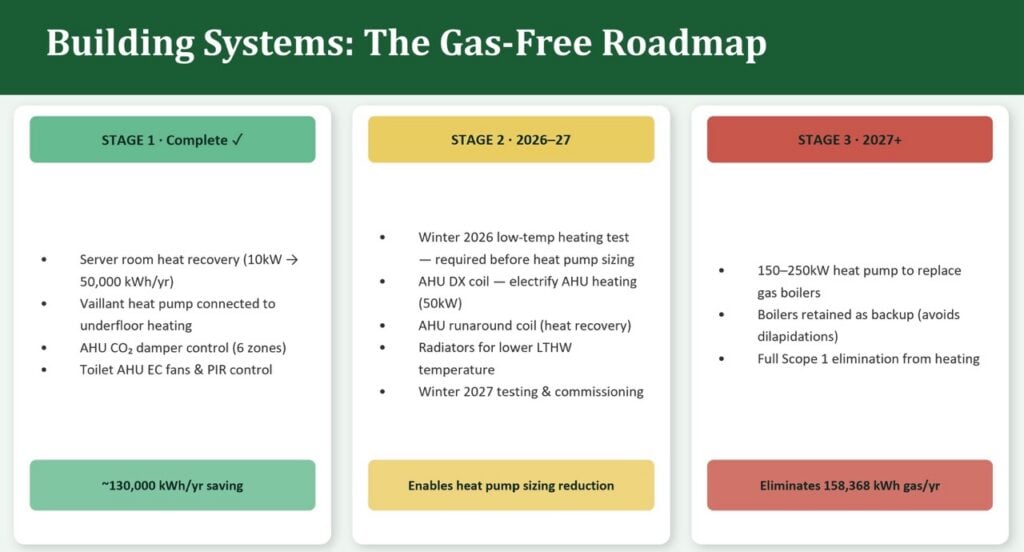
Our building services engineer cleverly suggested recovering heat from the condensers serving the air conditioning in our own server room. We’ve installed a condenser under our atrium staircase to gently blow the warm air from our server room into the building during winter. We’ve also upgraded the toilet and shower extractor fans to operate more efficiently on PIR, meaning they only run when someone is present. We’ve even installed AHU ventilation damper controls for each floor so that we have a tighter grip on the air we deliver, reducing strain on both the chiller and the boilers. All of this is now saving us around 130,000kWh a year.
What’s next?
But this still doesn’t quite get us to net zero on gas all year round. The last phase — and what I hope to report in the next blog post — involves installing three new pieces of equipment: a new AHU DX coil to electrify the heating of fresh air coming into the building, a bypass damper to recover and recycle already-treated air to reduce waste, and heat pumps to replace the boilers entirely. To heat the office over the course of a year, we anticipate needing between 150–250kW of heat output to meet approximately 300,000kWh of demand.
Separately, we’re bringing on a new warehouse that will be completely electric. The Raspberry Pi Store in the Grand Arcade, Cambridge, is also fully electric. While significant progress has been made, there is still much to do — here’s to reaching net zero in 2027!


No comments
Jump to the comment form