We use some essential cookies to make our website work.

We use optional cookies, as detailed in our cookie policy, to remember your settings and understand how you use our website.

This vintage radio streams music with Raspberry Pi Zero W

I can’t remember where this vintage YouTube video about Tinkernut’s radio project came up recently, but I can remember being surprised we hadn’t covered it here on the blog back in the day. We covered his Twitch-o-matic and Coke bottle spy cam projects, but somehow this music streaming radio slipped the net. So today I’m here to right a wrong.
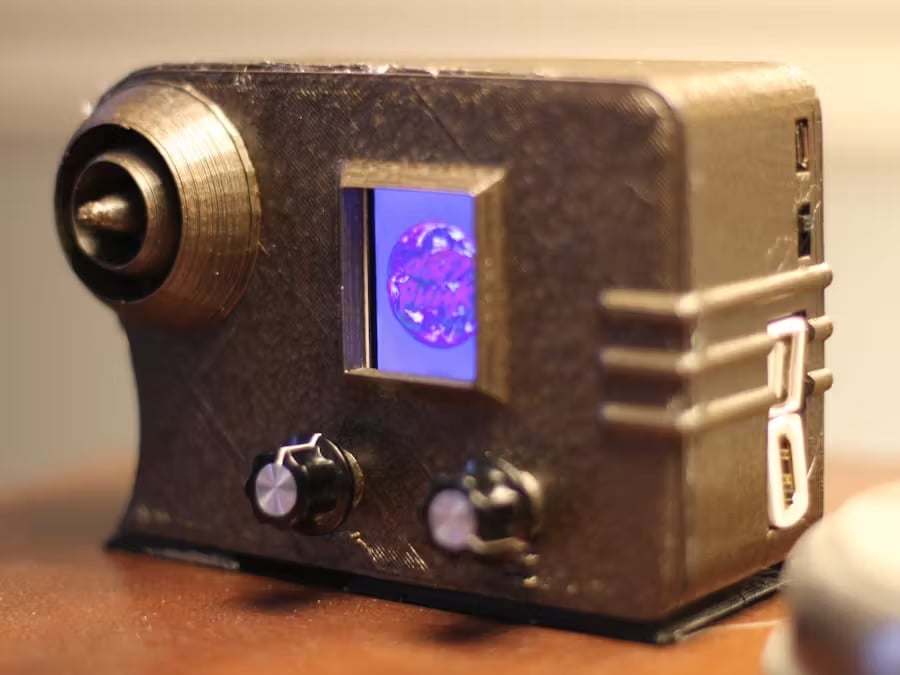
This image shows a close-up of a vintage-style object, which appears to be a small camera or possibly a customized decorative piece resembling a camera. It features a textured dark brown surface, possibly leather or a leather-like material, and metallic elements. On the left side, there's a prominent circular lens-like component. The front displays several details: a blue square panel with a graphical display, which interestingly shows an image of the Daft Punk logo. Below this panel are two small knobs, which could be dials for adjustments. On the right, there's a series of decorative metallic bars, adding to its retro or possibly steampunk aesthetic. This object could be a functional device with artistic modifications or a purely artistic creation meant to mimic the appearance of a camera.

Maker Tinkernut feels that modern radios look too “blah” to display in his home. Because we sadly do not yet have the technology to allow gorgeous vintage radios and plain-but-higher-quality modern sets to have babies, he decided to make his own.

The design in Tinkernut’s build video for this project is lovely. You should really give it a watch.

How does it work?

Digital-quality audio comes courtesy of an Adafruit MAX Mono Amp which pushes sound to the mini speaker. These both sit on an Adafruit Perma Proto Bonnet, which the Raspberry Pi Zero W wears.

Thanks to the Mopidy music server, the radio can play music from a local disk as well as pretty much any streaming service, including Spotify, SoundCloud, and TuneIn. You can edit the playlist from a phone, tablet, or computer.
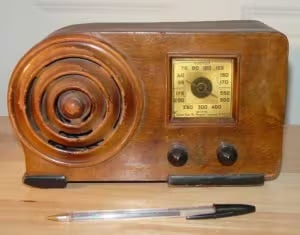
The image displays a vintage wooden radio from an earlier era, characterized by its classic design. The radio has a rounded, prominent speaker grille on the left, crafted with concentric circular patterns typical of mid-20th-century design. On the right side, there's a dial window displaying frequency ranges marked with both AM and FM bands, suggesting it's a multi-band receiver. Below the dial window are two black knobs, likely for volume control and tuning. To provide a sense of scale, there's a pen placed horizontally in front of the radio. The entire piece, with its wooden casing and design elements, exudes a nostalgic charm, reminiscent of the 1940s to 1950s radio design.
Tinkernut’s visual inspo

Tinkernut’s inspiration for the housing came from a 1938 wooden Emerson clock radio. He modelled an homage to it in Tinkercad before 3D printing the parts and spray painting it in a bronze textured finish. Très retro.
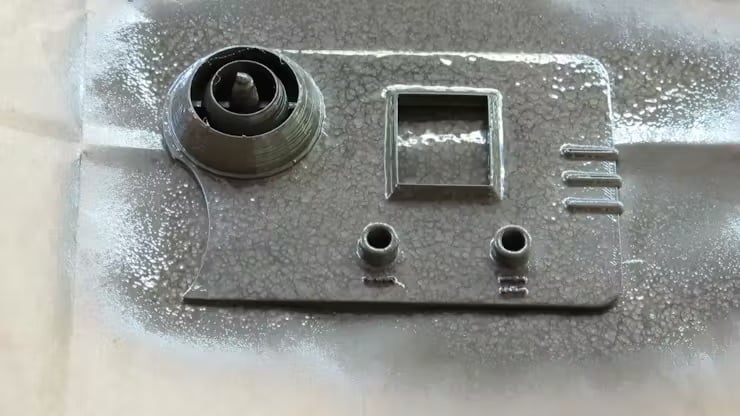
This image features a close-up view of what appears to be a metallic object, possibly a component of a machine or tool. It's situated on a slightly reflective surface, perhaps wet or oily, which enhances the texture contrast. The metallic object is comprised of several elements including a cylindrical piece with a threaded interior at the left, a square frame in the center, and three smaller cylindrical elements towards the right that seem to be hollow. The entire assembly has a textured, rough surface, indicative of a casting process or similar manufacturing technique. The layout and arrangement suggest that these components could be part of a larger mechanical assembly.
Fancy spray paint finish

Blending the old and the new

The maker was careful to include little touches like physical knobs to control volume and power, enhancing the user experience by retaining the tactile interactions you used to have with older devices. He juxtaposed that with the modern touch of a 1.8-inch LCD screen to display album art and user feedback. The best of both worlds.
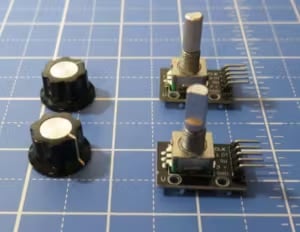
The image showcases a set of electronic components, specifically potentiometers, mounted on small breakout boards. There are three potentiometers in total. Two of them are equipped with black knobs, placed separately from the third component, which is mounted on a board and also features a silver metallic knob. The potentiometers on the breakout boards have pins on the bottom for easy integration with other electronic projects or breadboards. The setting is a blue grid background, typically used as a cutting mat or work surface in electronics or crafting, which helps in measuring and aligning components precisely. This setup is commonly used in DIY electronics for controlling volume, lighting, or other variables.
Clicky and pushy buttons

Tinkernut would love for all of you to reject your new-fangled, soulless fixtures and build your own retro radio. He has created a detailed guide offering step-by-step instructions from initial setup to final tweaks, including managing software through SSH and ensuring the device boots properly. My idea of a vintage radio is the canary yellow one with a CD player in the lid and a tape deck on the front that we all bought from Argos in the 1990s, so I don’t think I’ll bother reviving that visual monstrosity.
4 comments

Andrew Oakley avatar

Any chance of a Pi Zero 2 W with more RAM please? Basic stuff like LibreElec will no longer work on 512MB RAM. We need, at least, a 2GB option. Pretty please?

Stu avatar

I’ve not tried it but OSMC still works with the zero 2 w.
https://osmc.tv/download/

Nicholas M. avatar

Hopefully, a Raspberry Pi Zero 3 WH with 2 GB RAM and USB 3.0 port becomes available soon.

Mike Mulrooney avatar

Great project thanks for sharing
I am looking for other radio projects especially scanning

Comments are closed