Raspberry Pi Flash Drive available now from $30: a high-quality essential accessory
A USB flash drive is one of those small essentials you reach for from time to time to back up data or transfer files between your Raspberry Pi and substitute computers. For basics like these, it’s tempting to reach for the cheapest thing on Amazon or whatever you find in your local supermarket, but you can easily end up with a device that has sluggish read and write speeds, fragile casing, or – worst of all – far less storage capacity than it claims. Better to go with something you can rely on: introducing the Raspberry Pi Flash Drive, a compact high-capacity USB 3.0 USB‑A device with fast data transfer and an all‑aluminium enclosure. It’s available now at $30 for 128GB, or $55 for 256GB.
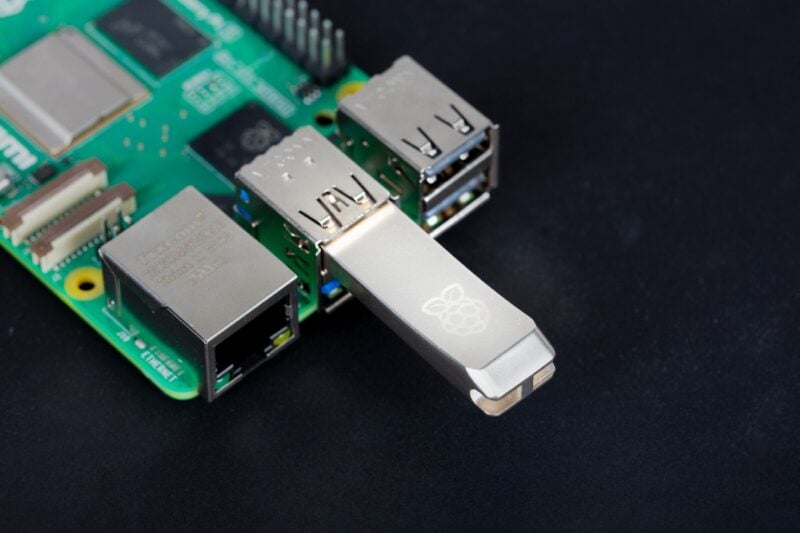
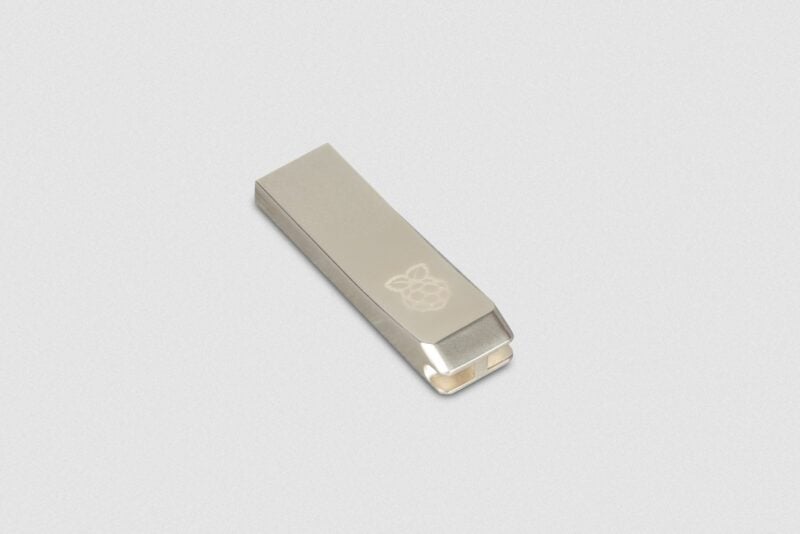
We’ve brought our usual exacting standards and attention to detail to our new accessory. It can sustain a write speed of 75MB/s (128GB variant) or 150MB/s (256GB variant), and our thorough testing has made sure it can handle the demands of real life when it comes to sudden disconnection and power failure. Its ergonomic all-aluminium enclosure is easy to grasp and almost impossible to break, although you’ll manage it if, like jdb of this parish, you go at it with a blowtorch. It has an attachment hole so you can keep it on a keyring or similar. The Raspberry Pi logo is etched with classy understatement onto its upper surface.
Fast and robust
Like many high-density NAND flash storage devices, the Raspberry Pi Flash Drive employs a small reservation of pseudo-SLC cache to improve performance under burst-y write workloads. In the background, any writes that were allocated in pSLC are streamed out to the higher-density, but slower, QLC flash. There are significant advantages to doing this: for short periods, the sequential write speed can be almost as fast as USB 3.0 will go.
This cache does, however, make benchmarking challenging. For this reason, the USB 3.0 performance figures we quote are sustained figures, where writes are measured when the cache is forced to do write‑through due to the volume of writes already committed, and reads are measured with the cache empty.
It goes without saying that whatever internal storage arrangement is used, it must be robust against surprise removal or power failure. We verified that our new flash drive meets this requirement over tens of thousands of random power cycles while running intermittently intensive I/O workloads.
Bonus features
In addition to being fast, we made sure that these drives support SSD-style SMART health reporting to help you to manage the device lifespan, as well as supporting TRIM operations. They will also autonomously enter low-power USB 3.0 states when idle.
More handy essentials from Raspberry Pi
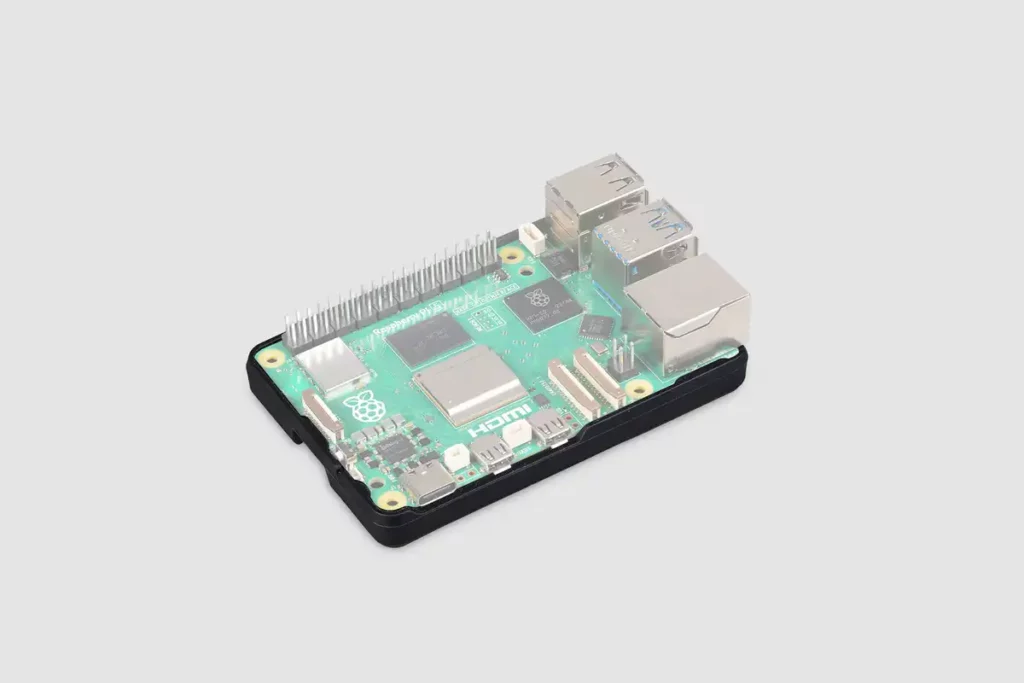
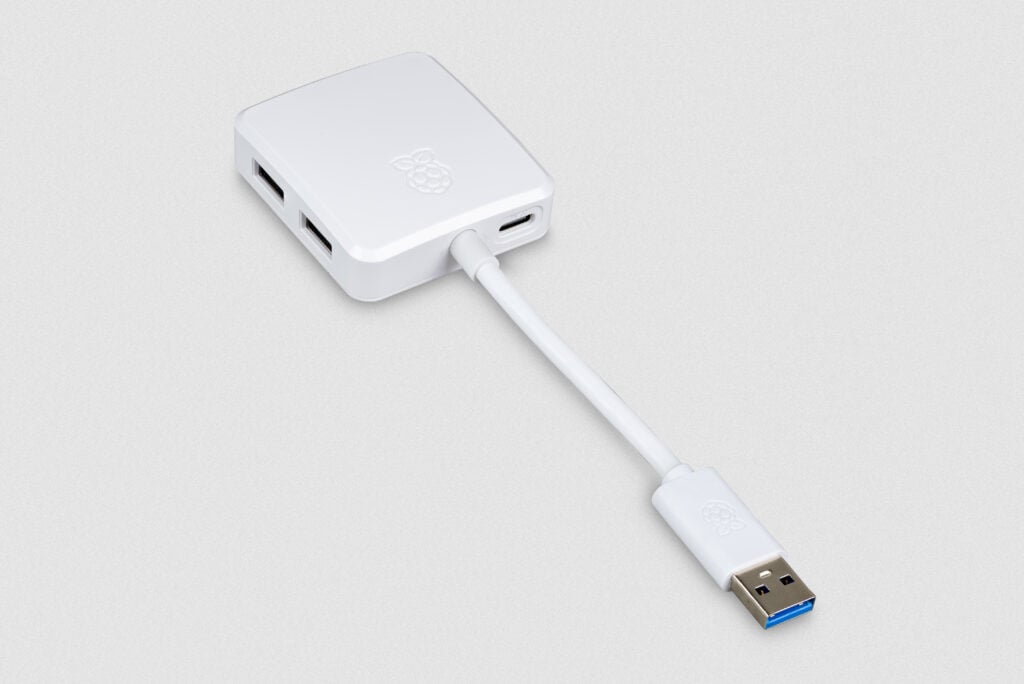
Our new flash drive joins a growing range of rigorously specified and robustly tested Raspberry Pi accessories designed to make your day-to-day computing life as friction-free as possible. Raspberry Pi SD Cards and Raspberry Pi SSDs offer you a choice of storage solutions; the four-way Raspberry Pi USB 3 Hub provides an excellent alternative to unsatisfactory price/quality compromises elsewhere; and the Raspberry Pi Bumper is exactly what you need to protect the base and edges of your Raspberry Pi 5, without obstructing access to anything else.


The new Raspberry Pi Flash Drive gives you compact, portable storage with reliable performance for both 128GB and 256GB capacity options. Grab one from a Raspberry Pi Approved Reseller today.


28 comments
Jump to the comment form
AndyD
These look very nice. Useful for lots of things. Very nice aesthetics too.
Misel
Daaaaang, it’s basically an SSD in USB stick form. Very nice! :)
mrlinux2U
I had an old Sandisk flash drive that had an SSD controller on it (they don’t appear to be made anymore) and it performed really well when running my Pi 4 OS from it (much better than using an SD Card as primary storage).
Also, having TRIM & SMART functions built in should make this a very reliable USB drive.
Olydnad_SWE
SanDisk Extreme PRO has TRIM and SMART. Not cheap to buy, but fast. Around 420MB in read and 380MB on write. I have a few 256GB of them. Raspberry Pi USB looks nice and will buy some of them too.
mrlinux2U
Nice addition and just ordered one for testing.
Any idea what the MTBF and TBW values are by any chance?
jdb
Endurance figures are available in the SMART data – both CrystalDiskInfo and smartmontools provide sensible names for the available fields.
ukscone
Those look cute
horace
nice! :) i am a bit sceptical about QLC though. i always avoided it so far.
fanoush
Oh, that’s great! I just started using raspberry microsd cards with cheap (~US$3) USB 3.0 card readers from aliexpress and was happy I have very cheap storage with reads in 80MB/s range for the really cheap stuff to boot from, and now you come with this just when I figured out those readers do not handle trim anyway :-)
So now the only reason to be still happy with my solution is that the 128GB is too big and expensive. If you would release 64GB or 32GB version for half or 1/3 of this than I would really be doomed and would need to reconsider.
So please consider making smaller capacity version :-)
rclark
Nice. The only thing better would be nice ‘short’ ones for project use.
However, probably buy 180 degree USB connectors to tuck under though but then have to be careful of shorts. or 90 degrees left, right, up, down. Get creative to make more compact. I probably pick up a couple in time. I normally use external SSD drives for booting OS and storage on larger projects and SD Cards for really compact projects.
Edge
Interesting idea but wheres the big YT launch with comparisons between usb 3.2 devices on usb 2 and 3 interfaces 🤦🏻
elliott
I just got it and it is so useful I love it
Mike
It’s too long. Please try to make it shorter/smaller.
YKN
Are these faster then the Raspi microSD cards?
jdb
Yes, considerably at USB3.0. But even at USB2.0 speed, they still achieve 12-13k random IOPS. Much better than SD cards running at DDR50/SDR25 on Pi 4 or older platforms.
russell
Not mentioned but an important benefit: the drive width appears to be barely larger than the connector. Many of my old flash drives have a body notably wider than the connector, which crowds out anything from using adjacent USB ports. In fact that’s why I had to get the Pi USB hub for my Pi 400.
Pricing looks … like you have to account for more than merely the storage capacity when evaluating the value it offers. I have a much cheaper 128 GB drive, but it may be significantly worse in every way but capacity.
MarkB
Can these be used as a boot device? Might make for a good upgrade for anyone who needs to replace (me) an sd-card using server, but doesn’t need a full on m.2 setup
jdb
That’s expressly an intended use-case for these.
rclark
Yes. You have been able to boot from USB drives for quite some time now. I’ve always used USB 3.0 SSD drives (like Samsung T5s, T7s) on my 4s and 5s where it made sense. Still do. Much more reliable, bigger capacity and you get full USB 3.0 speeds. Win Win and Win.
andrum99
Ooh shiny. Any chance of some 32GB and 64GB variants? 🤔
Pieter Groeneweg
I wish they made them shorter. This length makes them vulnerable in projects.
Now I boot from SanDisk Ultrafits because of the size and being faster than the Micro SD.
I would like to find a similar small size with metal housing instead of the SanDisk Plastic as they can become hot.
Raspi
Isn’t this the same price as an ssd.. can still get a sata ssd Samsung 120gb for $40 with triple the speed…
rclark
I just looked on NewEgg and don’t see exactly what you talking about. SATA isn’t USB either. So even if you found one, you have to add an adapter, a case, etc. to ‘make’ a removable thumb drive.
Anders
I have one arrived today. It’s a little package of smallness and well thought out design. It also has useful metal surfaces that suit engraving. It has its size on the side, but I will probably use coloured dot stickers to identify each by its purpose.
ffries
Is firmware freely available and upgradable?
David Black
Nice device!
Didn’t see it mentioned, (for those who have bought one) does it include a write protect switch?
Many thanks.
Adrian
This seems a very unnecessary and overpriced vanity accessory while we’re all still waiting for the long-promised RP5-compatible PoE HAT.
Kent Bog
Can a Raspberry Pi 4 power two of these at once? I would like to do that for software RAID 1. Can they reliably boot the Pi?
I recently tried this with Verbatim USB drives…and they couldn’t do it. I concluded they draw too much power. These?
Thanks,
-kb