Name your own price for this Humble Bundle of Raspberry Pi Press books
Update: Humble Bundle have extended our bundle until Monday 17 November at 11am Pacific, so you have a few more days to get your hands on these fantastic titles.
In recent years, we’ve made it easier to find Raspberry Pi Press books, whether it be online or on store shelves. We’ve now teamed up with Humble Bundle to let you name your own price for 16 of our e-books.
For $8 (roughly £6/€7), you’ll get DRM-free copies of our books, and your purchase will support the Raspberry Pi Foundation‘s work to help young people reach their potential with computing. Check out the All Things Raspberry Pi bundle, which runs from Monday 20 October to Monday 10 November. (The start and end time is 11am Pacific).
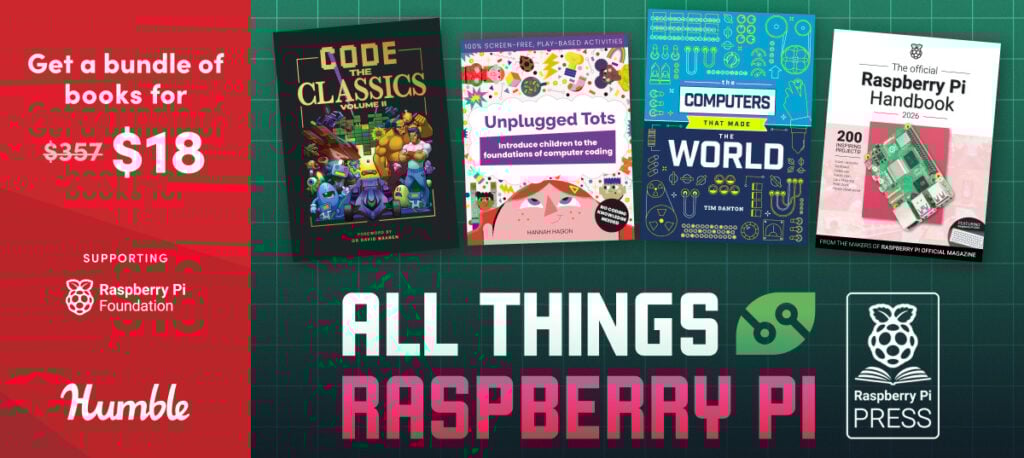
There are two tiers to the bundle. Pay at least $8/~£6/~€7, and you’ll get these three titles:
- The Official Raspberry Pi Handbook 2024: The best projects from a year of our official magazine.
- The Official Raspberry Pi Beginner’s Guide: Get your Raspberry Pi up and running, learn to code, and experiment with electronics.
- The Computers That Made Britain: The stories of 19 iconic computers including the ZX Spectrum, BBC Micro, and Commodore 64.
But wait, there’s more
If you pay at least $18/~£14/~€17, you get those books and more:
- Code the Classics Volume II: Write your own modern classics inspired by the greatest video games of the 1980s.
- Unplugged Tots: Introduce your child to the foundations of computer coding, screen-free.
- The Computers that Made the World: The story of the birth of the technological world we now live in.
- Book of Making 2026: the best makes from a year of HackSpace.
- The Official Raspberry Pi Handbook 2026: The best projects from a fantastic year of Raspberry Pi Official Magazine.
- Make games with Python: Coding your own shoot-’em-up game is infinitely more satisfying than beating any end-of-level boss.
- Simple electronics with GPIO Zero: Learn how to control LEDs, sensors, motors, and many more components from code.
- Conquer the command line: Make yourself at home in the terminal on Raspberry Pi.
- Experiment with the Sense HAT: Learn to use this official accessory that includes enough sensors and inputs to earn it a place on the International Space Station.
- The Official Raspberry Pi Handbook 2025: The best projects from another great year of our official magazine.
- Book of Making 2025: The best makes from another creative, inventive year of HackSpace.
- Get started with MicroPython on Raspberry Pi Pico: Learn to program Raspberry Pi’s line of microcontroller devices to interact with the physical world.
- Code the Classics Volume I: Write your own modern classics inspired by the greatest video games of the 1970s and the 1980s.
To learn more about these books, check out the All Things Raspberry Pi Humble Bundle for more detailed descriptions, plus previews. You can also browse our complete library of books on the Raspberry Pi Official Magazine website, and download back issues of the magazine too.






16 comments
Jump to the comment form
Tim Cliffe
This is an outstanding offer.
One can never have enough books.
Tim Cliffe
Speaking of books, well, magazines; in particular MagPi/RPOM, I have all the magazines; however, one issue (no pun intended) with having many magazines is remembering in which issue one read a particular article or found that piece of information that would be really handy right now.
I think it would be useful if Raspberry Pi provided a catalogue of the contents of all MagPi/RPOM to support the finding/revisiting of previously published information. This would also have the benefit of increasing the accessibility and usefulness of previous issues and essentially create an encyclopaedia of Raspberry Pi.
The catalogue could take the form of, for example, a searchable web page, perhaps called PiClopaedia.
It’s just a thought.
Helen McCall
Hello Tim,
Perhaps we need a group of volunteers to be established to create a community project to catalogue all these publications.
Tim Cliffe
Good morning Helen McCall;
That’s a thought.
There would need to be consultation with Raspberry PI to confirm specifications for content normalisation/data structure (I’m assuming something like a MySQL database and Raspberry Pi are willing to host the web page of course), together with a development plan and standards to support volunteers and ensure consistency of approach.
We would also need authoring standards and content reviewers together with a suitable GUI design and functionality specification.
All of the above is pretty standard for this type of activity, so very much achievable.
Yours is definitely a good idea.
Thank you for taking the time to reply.
With best wishes
Tim
Helen McCall
Hi Tim,
That is a very good breakdown of what we need to do.
To initiate the community project we need to write an article for RPOM asking for volunteers. If this means that we both form the nucleus of the project, we need to both ask Raspberry Pi to put us in direct contact with each other.
Then we need to draft an article for RPOM and get it approved by Raspberry Pi Ltd.
The biggest difficulty will be designing a contributions system which provides consistency between individual contributors, so that the catalogue meets Raspberry Pi Ltd’s high quality standards.
I give permission to Raspberry Pi Ltd to pass my email address to Tim Cliffe.
If you Tim ask them the same; we are in business!
Tim Cliffe
Hello Helen;
Sounds like a plan.
My background is in curriculum design, content, management, data normalisation and instructional design; experience I believe is well suited to your proposed project.
I never expected to be involved in the start a community project but, If people find it useful, I’m up for the adventure.
I give Raspberry Pi permission to pass my e-mail address to Helen McCall.
Dear Raspberry Pi, please note. Helen and I will need your support and approval for this community project to move forward.
With best wishes
Tim.
Helen McCall
Hi Tim,
That is brilliant. Now just to hope that Raspberry Pi Ltd get in contact with both of us.
Tim Cliffe
Hello Helen;
I’ve sent an e-mail directly to Raspberry Pi.
Hopefully, that will encourage a response to our proposal.
Take care.
David Held
Count me in as a volunteer. I’ve been thinking along the same lines.
Raspberry Pi Staff Lucy Hattersley
Hi Tim,
We have had this request from the community before and there have been efforts to set up a community-led database of articles. We’re really happy to help set this up but I’m loathe to take the team away from creating the magazine to databasing it.
If you want to create a database, or set up a wiki we’d help how we can. And I’m willing to put a file of contents on our GitHub where the community can add content and perform pull requests (I’d suggest a text file such as csv).
All of our magazines are available in PDF form. And contents are available on each page. For me, I find PDF search along with Google and now LLMs enough to do research on what article was in which magazine. YMMV, as they say.
Why don’t you have a think about what kind of content you would like in a text-based csv database and do a test issue. Go through say issue 159 and put together a database. Then we can host it and gather feedback.
Tim Cliffe
Good evening Lucy Hattersley;
Thank you for your reply; most kind.
I suspect assumptions are being made, which may or may not necessarily be valid.
Firstly, the idea of a database of searchable MagPi/RPOM content may seem like a good idea; however, the general community may not agree. To determine this, for example, a News article describing the proposed function may solicit opinion from the community.
If the community support the idea, there follows a period of scoping to determine, for example, who is available to do what, what must be known and who is available to provide that knowledge.
What software can be used to develop and broadcast the functionality, a specification for development, authoring standards, gatekeeping, who will review the issues, etc.
None of this is yet known.
It may be, for example, Raspberry Pi simply provide details of what software is compatible with Raspberry Pi systems and the memebers of the community project are responsible for content normalisation, quality assurance activities and the like, populating the database etc.
It may be, Raspberry Pi are, necessarily, mainly involved with the integration of the search function into web pages and the installation of the populated database.
In essence, until we have community support and know who is available to what and thereby understand the activities community project members must undertake, we don;t know anything at present. We only have an idea.
With best wishes.
Tim
Roger Manemann
Excellent Idea!!!!
Charles Anderson
Will there be electronic versions of any of these that will be available for those who purchase a bundle, or even for the general Pi Public?
Brian Jepson — post author
Hi Charles, the bundle is ebook-only, and includes PDF versions of all books, as well as ePUB versions of most books.
DistroEx
This Bundle was extended to 17 November.
Raspberry Pi Staff Ashley Whittaker
TRUE STORY!!!!!!