Colour Word Clock | The MagPi #143
The GurgleApps siblings return to their roots with this fun and practical word clock kit. In the brand new issue of The MagPi, out today, Rob Zwetsloot spends some time with it.
Gurgle Apps has been making fun electronics projects (and tutorial!) videos for years now, and we’ve included what they’ve made in the mag several times. The three siblings Amelie, Caleb and Zivya are back again in these pages with a kit that you can actually build yourself – the Colour Word Clock.
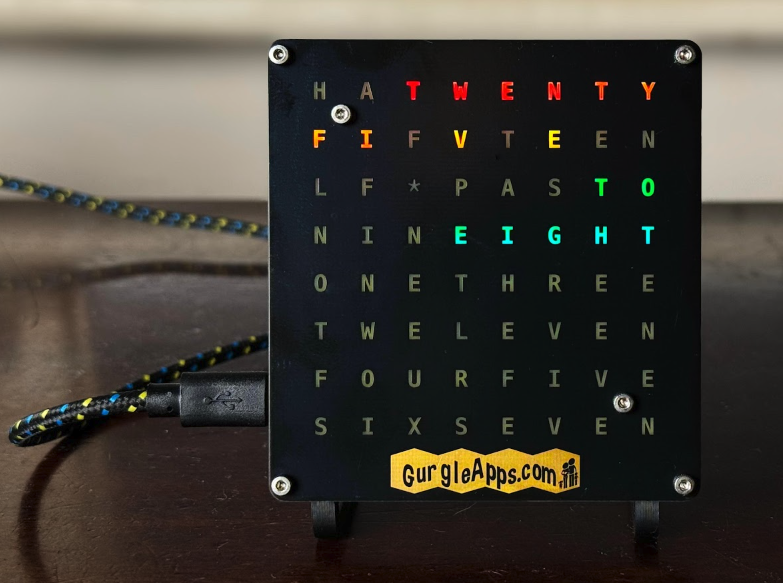
“One of our first ever projects was a tiny 8×8 LED matrix word clock using a Raspberry Pi,” the siblings explain to us. “At that time we were too young to do it on our own, our Dad made it to teach us a bit of Python and electronics. We remember making little pictures on an 8×8 grid on paper then turning it into binary then hex to get it to display on the LED matrix.” (Video below).
“We wanted to make some kind of kit for people to build and hack and remembered that fun little project,” they continue.“[It] can be controlled via a web interface on any device connected to the same network. The clock displays the time in words and has a variety of display modes… It was important to us that the code was open source and the kit was easy to build and modify. The kit is aimed at beginners and experienced makers alike. It was also important to us that the kit was affordable, and if you don’t want to buy the kit you can build it yourself using the open-source code and easy-to-source components, and 3D-print the case. All the case files are open source and free to download.”
Reliable Pico
The wireless capabilities of the project were extremely important to the siblings.
“We’d just open-sourced a MicroPython Web Server to control projects using a browser, and thought it would really show off what it could do,” they say.
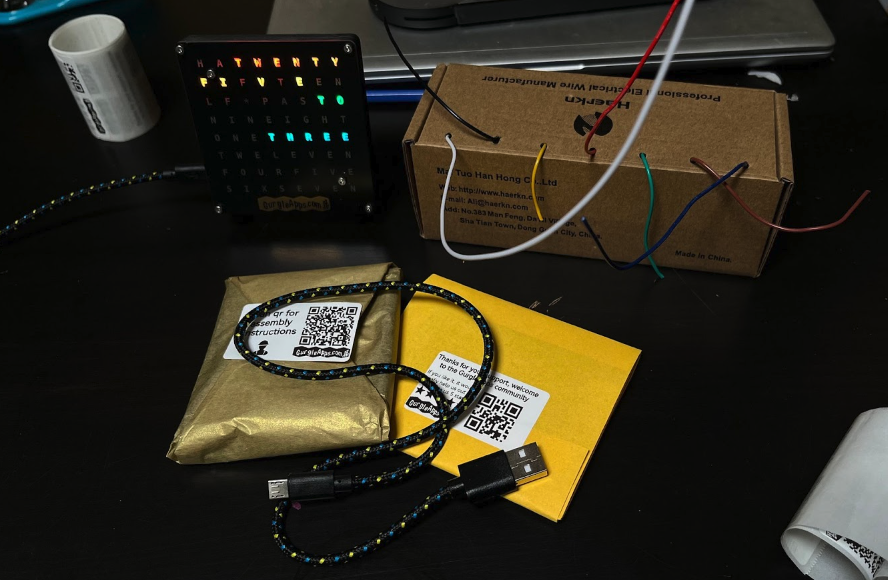
Despite their love of Raspberry Pi Pico (“we usually use Raspberry Pi Pico unless there is a specific reason to use something else,”) they began experimenting with another microcontroller, however it just couldn’t hack it.
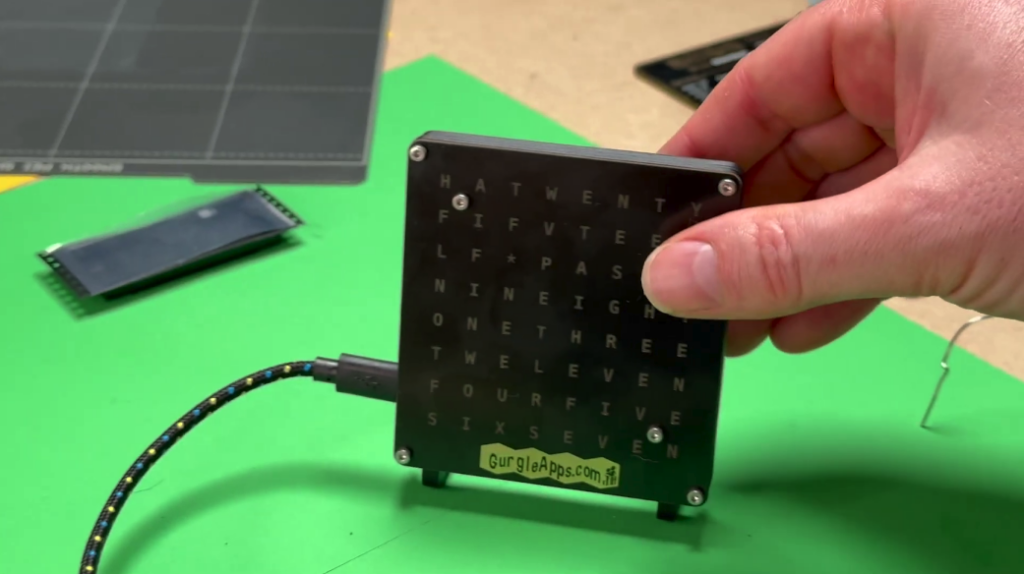
“We found the Wi-Fi connection degraded when we left it running for a few days, we went through four different [microcontrollers] and they all had the same issue,” they explain. “At this stage the clock was still a tiny 8×8 LED matrix word clock which used I2C and SPI, and we also had intermittent issues with the I2C connection. We have so many Raspberry Pi Picos lying around that we decided to try one of those and it was bulletproof from the start.”
Like a lot of products, the clock went through many design changes – as you may have noticed, it definitely doesn’t ship with a tiny 8×8 LED matrix.
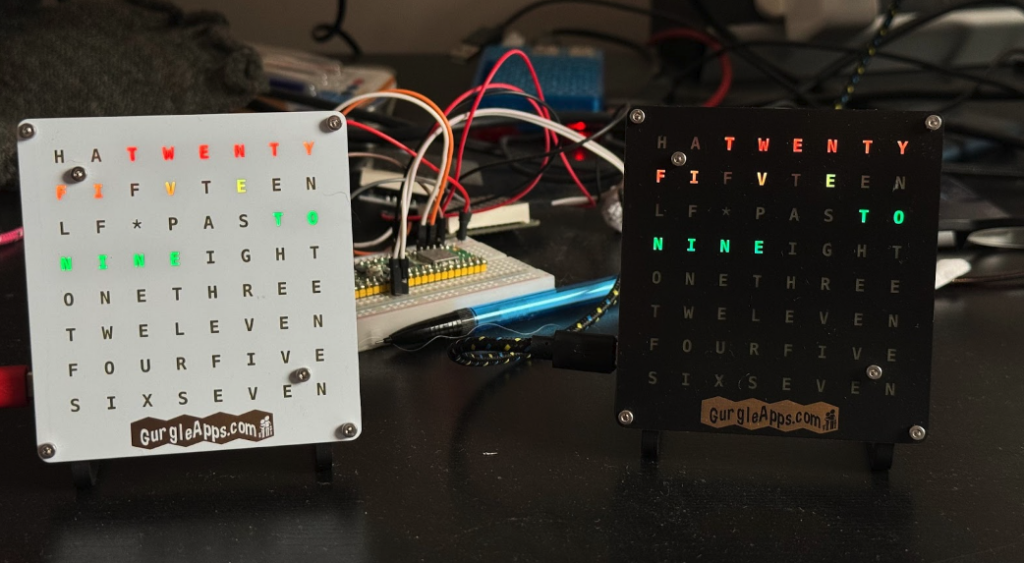
“If you’ve seen any of our videos you’ll see projects stuck together with Blu Tack and gaffer tape, but you can’t do that with a product you’re going to sell,” they admit. “We went through hundreds of different designs and prototypes. The 3D-printed faceplate alone we tried with dozens of different fonts, sizes and colours. Dropping the small 8×8 LED matrix was a big decision, we had to start again with the code and the faceplate. We had to make the clock bigger to fit the larger LED matrix and completely redesign the case but it started to come together and look like a product we’d be proud to sell.”
The MagPi #143 out NOW!
You can grab the new issue right now from Tesco, Sainsbury’s, Asda, WHSmith, and other newsagents, including the Raspberry Pi Store in Cambridge. It’s also available at our online store which ships around the world. You can also get it via our app on Android or iOS.

You can also subscribe to the print version of The MagPi. Not only do we deliver it globally, but people who sign up to the six- or twelve-month print subscription get a FREE Raspberry Pi Pico W!


2 comments
Simon FD
This was given to me as a Father’s day gift (the clock thing not MagPi). Terrific little project!
Raspberry Pi Staff Ashley Whittaker
Excellent!
Comments are closed