Can a Raspberry Pi Pico act as a GPU?
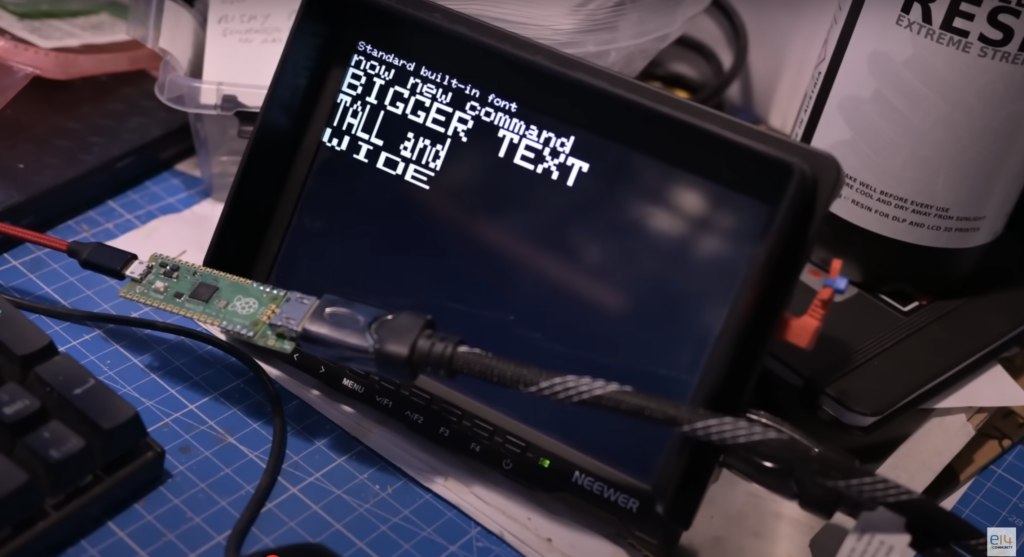
Clem from element14 was tasked with exploring the possibility of turning a Raspberry Pi Pico into a GPU capable of rendering super-smooth graphics in-game. Yes, you read that correctly — he’s not attempting it with our monster new Raspberry Pi 5, or even a 4; he’s giving our teeny tiny little Pico a shot.

Gamers are serious about GPUs: they can spend thousands of pounds on them. Now, I’m not a big gamer, so I didn’t quite believe that, but a three-second search for most expensive GPU threw up this statement: “the Nvidia A100 graphics card goes for upwards of $30,000.” What?! Well, I’m perfectly happy with my jerky Rollercoaster Tycoon visuals, but I love that the rest of you want better for yourselves.
So, can a Pico do it?
Rather than reinvent the wheel, Clem drew on the PicoDVI project by our very own Luke Wren. This takes advantage of Pico’s PIO to bit bang DVI signals.

A previous project had seen Clem manage to get Linux running on a little ESP42 board he had designed himself. That board had a spot for one of our RP2040 chips; Clem didn’t ultimately use RP2040 in that project, but this new quest to turn a Pico into a GPU meant it was time for it to shine. Clem prototyped for this project with a Raspberry Pi Pico and a few wires, just to see if it was even possible, before spending time reworking his ESP32 board.
Long story short, after flashing some example graphics libraries onto his Raspberry Pi Pico and tinkering with Arduino’s IDE, Clem was satisfied that his Pico prototype operated just like a plug-and-play video game graphics card. This summary doesn’t do justice to Clem’s determination in working through a series of setbacks during prototyping, so make sure to watch the project video if you’d like to learn more about the build process and suffer vicariously in solidarity with this valiant maker.
Final product in the works
While he didn’t get his reworked ESP32 board completed in time for this project video, Clem has gone ahead with bringing his vision to life. He hopes to see it bring in a new, more affordable, future for gamers looking to harness microcontrollers for their graphics processing power.




7 comments
N0Fr3
Great article and video ! Name one thing this little beauty can’t do. I’ll wait, lol.
Raspberry Pi Staff Ashley Whittaker — post author
Our friends at element14 do come out with some interesting stuff.
Michealtheratz
Do floating point math (the RPI pico is still pretty cool though)
Alex
I think there is a little mistake in the article. Clem used the ESP32 in his Linux project. I don’t think the ESP42 even exists…
Raspberry Pi Staff Liz Upton
Thanks – fat-finger syndrome! I’ll go and fix that.
Charlie
Hmm, reminds me of the PicoVision. Except that has even more pico. (and someone with a suspiciously similar name to mine used it for a 3D renderer demo)
Grant
No one is buying a Nvidia A100 GPU to run games. That thing has 80gigs of vram and is mostly used for everything besides gaming like running large open source language models, or AI things. You need a server chassis to cool it properly.
Comments are closed