We saw a Pi running underwater at CES in Las Vegas!
Wheeeeew the desert is cold at this time of year. We have just returned from CES in Las Vegas, US, and we were thrilled to see so many innovative products using Raspberry Pi technology.

One of our favourites has to be this Raspberry Pi 4 running perfectly happily underwater. Not only that, but the submerged board is running the video reel for HZO’s CES booth, and they’ve toured it around the country at various events for almost ten years now. The Raspberry Pi is connected to both USB C power and micro HDMI video out, which feeds a monitor on dry land.
How is it running underwater, you ask? Well, HZO is a company that specialises in thin-film and nanocoating solutions. To prove the durability of their products, they coated a Raspberry Pi in one of them and chucked it in a tank full of water, where it stayed alive for the duration of the conference. Keeping one of our tiny computers going in very wet conditions for just a few days is impressive enough, but our jaws hit the floor when we learnt that there is a Raspberry Pi that has been running underwater in the lobby of HZO’s building for 525 days and counting. I definitely could not hold my breath for a year and a half.

HZO’s mission is to free electronics from the constraints imposed by things like dust and humidity, making them accessible to people living and working in more rugged environments. They also do work for the aerospace and defence, life science, and automotive, and mobility industries.
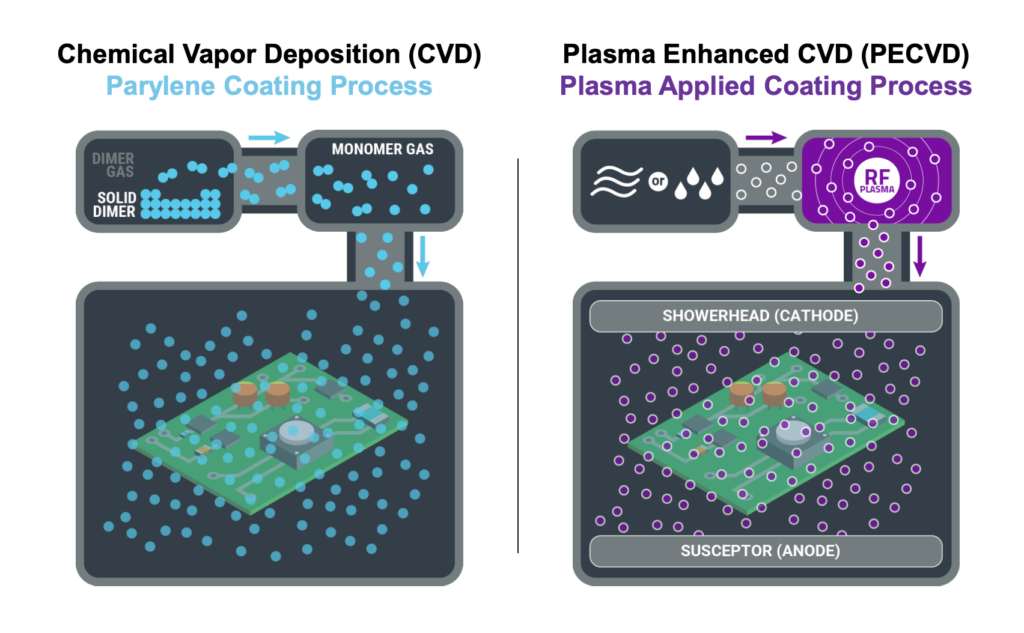
We’re not sure which treatment our tiny green computer got — HZO produces a number of specialised coatings. Perhaps the Raspberry Pi got a parylene coating, as that seems to be a highly water-resistant and submersible option. They also offer plasma-applied coatings that are apparently a good low-cost option if you’re not going to be chucking your tech into the deep on a regular basis. Here’s an excellent diagram from HZO showing how they apply some of these.
Let’s all gather in the comments and throw out suggestions of things we could do with a Pi if it were safely coated in some HZO magic. I’ll go first. We could go back in time and teach Ariel programming so she didn’t have to literally and figuratively give up her voice to chase Prince Eric as the only viable option to broaden her life chances.



19 comments
Anders
I would bet that the water is very deionised / distilled to high level of ion free purity. I can’t see if there’s a lid on the tank to keep the water from being contaminated from dust / atmosphere.
Ryan Moore
Hi! I can attest it is in fact, good old fashioned Las Vegas bathroom tap water. Source? Me, I filled it myself. :).
Bob
So was the Pi board coated with the mating connectors in place and then never removed?
Sam
Look at all the deposits on the glass, that’s definitely not purified water.
Dirk Gently
How deep can I Pi go?
Will we see a FishPi or a Davey’s Locker Pi? Brings ideas – a naked Sub Pi (for English-English speakers that would be a Bagutte Pi !).
Really though – imagine a Pi and all the gubbins of a ROV (motors etc) coated in this stuff with no outer waterproof casing, off into the deep – how deep would it get before…?
NB: Searching for an acronym can be educational – for HZO I got: “Herpes zoster ophthalmicus (HZO) refers to shingles affecting the ophthalmic branch (V1) of the trigeminal nerve”.
Raspberry Pi Staff Ashley Whittaker — post author
This loopy comment made my Friday ❤️
Ryan Moore
Sometimes in life you share an acronym with an unfortunate optical disease :(.
HZO is a play on “H2O” though we can protect against much more than that!
Yes, we would love to see how deep a Pi can go!
stan423321
We C++ programmers understand your pain. Though HZO is no std::vector.
Jack Horry
Interesting in how the coating affects the thermals in and out of the water.
Carlos Luna
So now I can play Doom on my Raspberry Pi while in the shower and have the water heated by the Raspberry Pi itself? 😂 (Pi Shower – you heard it here first!).
Louie
How do cables and ports work with these coatings? Does the board have to be coated with all cards/connections in place, and then loses the ability to ever detach or connect new devices?
piyavking
Hmmm…
Brilliant cooling decision, seriously. And I can’t understand, what’s happening with Pi on 566 day and later, they simply finished expirience?…
Tony
What are the effects on humans and the environment from the molecules used in this coating?
Robert M Rubano
I also am interested in how connection points work with this coating. Was the board treated while the power and hdmi cable were already connected or does this film not interfere with the connection somehow? If we attempt to attach new hardware to it or remove old connections do we re-apply the coating?
carmatic frua
My question would be, how do they waterproof the ports which need to be connected? The USB for power and the HDMI for video…
Emir
525 days underwater. Very impressive !
Eric Howland
As several people have suggested, I am assuming the cables were attached before the coating was applied. I would expect this would limit the depth that the board can function because at some relatively shallow depth the water pressure will crush the connectors since the air trapped in the connectors will compress as the water pressure increases. Then the connectors will short out. You would also need some pretty long cables if one end has to get to the surface.
Phil
Immersion cooling is a good idea. But we could use something other than water. Silicone oil, for example. The idea has been on my mind for some time. Has anyone tried it?
Raspberry Pi Staff Liz Upton
Yup!
Comments are closed