Watch the earth move with Raspberry Shake
Raspberry Shake was created on the slopes of Volcán Barú in Panama, thanks in large part to the support of seismology geeks on Kickstarter. The aim was to sell around 20 Raspberry Pi-powered devices to people they knew in the industry, but within a few days of the funding campaign’s launch, hundreds of Raspberry Pi enthusiasts and people wanting to detect earthquakes from home had jumped on board. It was at this point that the team decided to go back to the drawing board and create something proper, much more than just a cool gadget, to give people professional-grade seismographs at a more affordable price.
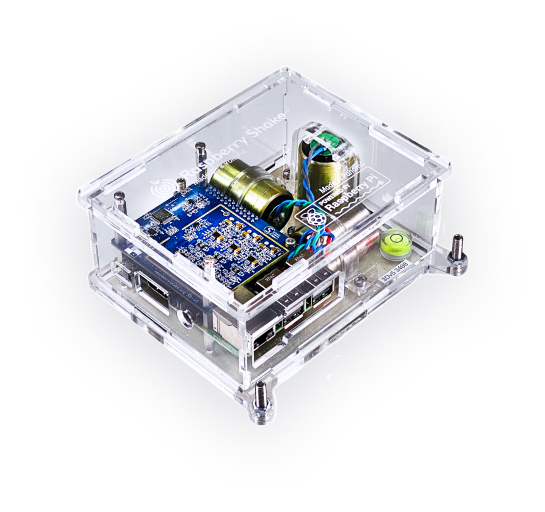
We’ve just added Raspberry Shake to our portfolio of industrial success stories. There, you can read more about how the device is made and how pivoting their design to incorporate Raspberry Pi gave them the boost they needed to break through after several setbacks.
Shake and boom
The team recently announced Raspberry Shake and Boom (RS&BOOM), their shiniest new product, still built on Raspberry Pi but with much broader capabilities than earlier devices. RS&BOOM can detect the shakes of the Earth and the infrasonic booms that bounce around our atmosphere. It incorporates the seismograph features of the original RS1D model, but with added infrasound capabilities.
Sharing shake data
Users all over the world share their seismograph’s data with the Raspberry Shake data centre, which is then available to use for scientific research and for everyday users to keep an eye on the Earth’s movements on the other side of the planet. The StationView app has recently had a massive makeover and the video below walks you through what’s new on the fully customisable interface.
Little icons on the map show where in the world Raspberry Shake data has been captured. You can filter your view by event date, shake type, and whether it was recorded by infrasound or seismic instruments. You can also search for Raspberry Shake stations by country. Give it a go yourself here.
Any of you blog readers have a Raspberry Shake at home? Tell us where you’re based in the comments, and we’ll all go and look for your shake data on StationView!




10 comments
Jeff Geerling
When I learned about the Shake, I found out the University u attended had already been running one for a couple years! (Alongside way more expensive USGS equipment). I was excited to get my own going (still is, here in St. Louis), and also to talk to a great geosciences researcher at the University who still shares his deep knowledge of all things seismic: https://www.jeffgeerling.com/blog/2022/watching-earth-move-raspberry-pi
Wayne Wells
I had known about these for a while but price kept holding me back in what myself and everyone else in the area thought was an earthquake-free area.
Wrong on that. Not long after I got mine set up and stable little town about 5 – 6 miles away started having earthquakes. All were mild but a mild 3 sure got my attention. Surprising part to me was how loud it was. My Shake is closest device to where these earthquakes.
In a convoluted sort of way a geologist at the College of Charleston contacted me asking for permission to use my data which I gladly said yes. To have a geologist use the data from my Shake is sort like the cherry on top for something I bought with little expectation of picking up anything but trucks and trains. To weigh in on an earlier comment, earthquakes I’ve seen have a unique signature.
Subsequent to that, my data was used in an annual meeting of geologists.
Raspberry Pi Staff Ashley Whittaker — post author
Niiiiice Wayne! Glad you went for it in the end .
Marco Walther
I’m still running one of the original Kickstarter Shake1’s😁 R5663 in Tracy, CA.
andré
How do you distinguish between a heavy truck passing your house and a seismic vibration?
There are oil drilling cylinders stuffed with earthquake sensors. How do you connect them to your Pi5?
I wish you great success, but I’m a little skeptic
David Fowler
It is actually quite easy to distinguish between a heavy truck passing (an most other anthropogenic noise) and a seismic event (an earthquake). The spectra are quite different.
As far as how to connect them, the various Raspberry Shake versions consist of a card (hat) that plugs onto the Raspberry Pi GPIO pins. The seismic sensors (geophones) are connected to terminals on the card. The Raspberry Pi runs custom software that records the seismic data with an option to report the data to the Raspberry Shake network.
David Fowler
I was part of the original Kickstarter campaign, and have been running a Raspberry Shake “3D” (triaxial geophones, weak motion detector) and “4D” (vertical geophone and triaxial accelerometers, strong motion detector) since they first came out. I live in a seismically active area and detect an average of over 8,000 earthquakes a year (6,000 from the local geothermal area). My RS3D is on the ShakeNet as R57B0. :)
David Drake
I have been running a shake/boom unit for over a year. It has been one of the best products I ever purchased and was very easy to set up. Near San Diego we occasionally hear unusual low frequency events and as you can observe multiple devices in the RS network, there is a good chance to localize them. The military training events at Camp Pendelton are well known, but off shore events are not well characterized. If you go to the RS forum under applications, you can see my geoseismic sounding experiment, with software and data results. It is also intriguing to see the varying S-P times across the mountains in San Diego and Riverside Counties. One of the very best applications for an R Pi I have seen. You will not be disappointed!
Raspberry Pi Staff Ashley Whittaker — post author
So nice to see more Raspberry Shake users coming to the surface since we posted this!
Mark Vanstone
Cornwall, UK is a seismic quiet area, but we have identified over 2000 events since my school obtained a Shake 4D in December 2018. Most of the events are from distant locations, but we have also picked up some local earthquakes, quarry blasts and induced events from a local geothermal programme. The Shake is a great little device, which has opened up a very interesting hobby.
Comments are closed