Raspberry Pi’s commitment to longevity: a sustainable advantage
In a commercial landscape defined by rapid technological turnover, managing electronic waste and integrating sustainable practices have become critical for businesses. Raspberry Pi’s strategy is rooted in a commitment to long product manufacturing lifetimes and comprehensive software support, providing a tangible and effective response to these challenges. It establishes a clear competitive advantage by aligning our commercial interests with our efforts to be environmentally responsible.

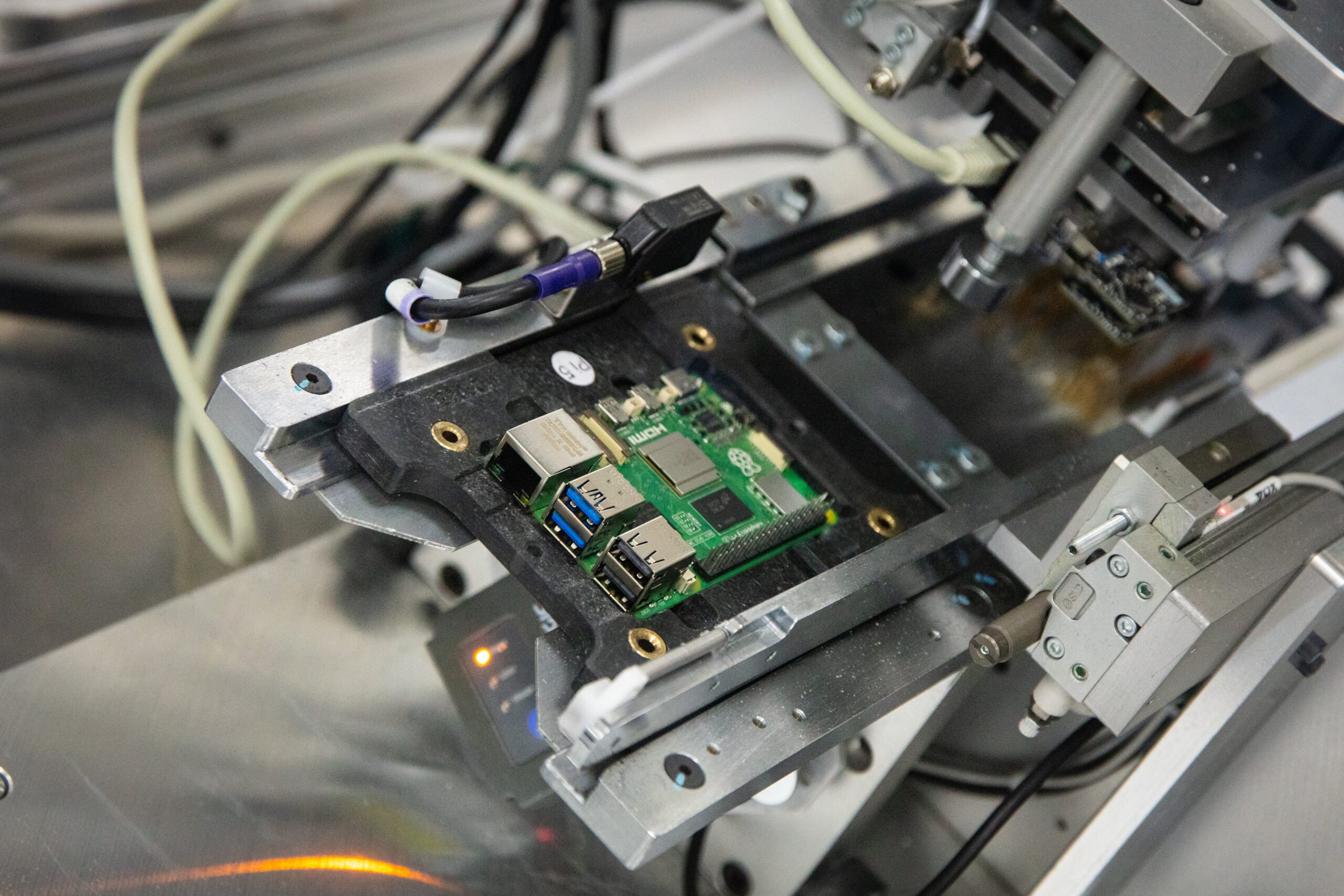
The frequent obsolescence of electronic components poses significant operational and financial burdens for technology companies. These businesses are often forced to undertake costly and time-consuming product redesigns, or even halt production completely, due to the discontinuation of a vital part. At Raspberry Pi, we mitigate this risk by pledging to manufacture our core products for extended periods. Take the flagship Raspberry Pi 5, for example: it has a guaranteed minimum manufacturing end date of January 2038, with production of many of its key silicon components extending as far as 2042. This long-term commitment provides our industrial clients with a high degree of supply chain stability, reducing the need for cyclical redesigns and generating less electronic waste.
This commitment to product longevity extends even to our earliest products. A customer can still purchase a Raspberry Pi 1 manufactured at Sony’s factory in Wales today, with hundreds of units still being sold each month. This continued demand and availability demonstrate the enduring trust that industrial customers have placed in the Raspberry Pi platform, a trust that is actively supported by Raspberry Pi.
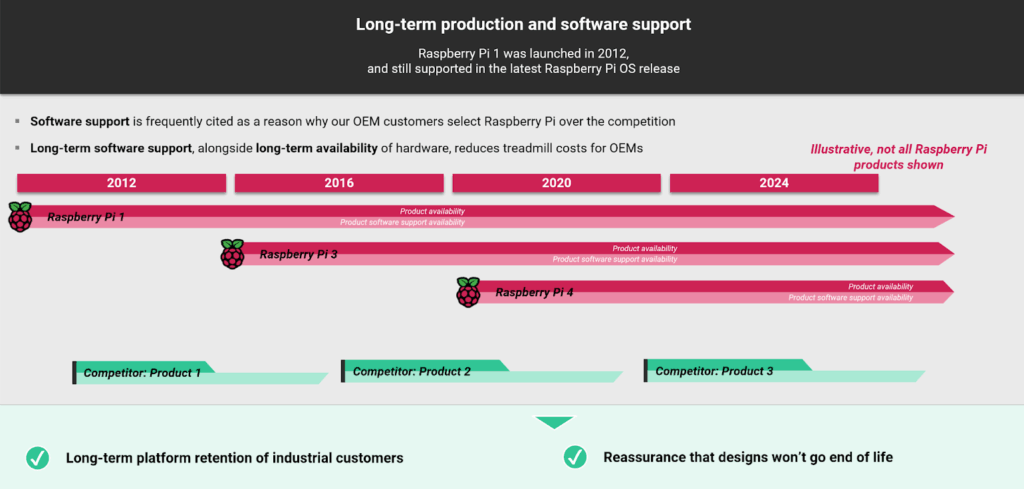
Longevity goes beyond hardware manufacture at Raspberry Pi; our policy of providing ongoing software support for all our products, regardless of age, is a fundamental pillar of our sustainability model. This contrasts with common industry practices, where support is often withdrawn shortly after a product’s release. By ensuring our devices remain functional, secure, and compatible through consistent updates, Raspberry Pi enables businesses to extend the operational lifetime of their embedded systems. This practice directly contributes to a reduction in electronic waste by decoupling the need to upgrade from the expiry of software support.
The practical benefits of this strategy are measurable for companies using Raspberry Pi. They include:
- Reduced electronic waste: long-term availability of hardware and software decreases the rate of product turnover, thereby lowering the volume of electronic waste.
- Cost efficiency: less frequent redesigns lead to considerable savings in research and development expenditure.
- Operational reliability: a stable, long-supported platform enhances the durability and dependability of industrial applications.
Raspberry Pi’s dedication to product longevity and sustained support isn’t just a corporate slogan — it’s a pragmatic business model. It enables companies to integrate a reliable and durable platform into their designs, and helps them contribute towards a more sustainable electronics ecosystem while simultaneously creating a strategic advantage in a market that increasingly values responsible production.

9 comments
Szaja
Few months ago I was able to buy the very first revision of the Raspberry Pi 1, which was missing in my collection. I flashed the SD card with newest Raspberry Pi OS Lite, connected it to the keyboard and monitor, and it worked. Just like that, despite being 13 years old and having only 256MB of RAM.
Helen McCall
Dear Szaja,
I still have my original Pi 1 which was given to me by a friend all those years ago because he thought I might be interested in it. I was immediately impressed when I plugged it into my old Sony monitor and suddenly had this tiny but fully useable computer working. I think I might do what you have done, and put the latest Raspberry Pi OS Lite on it, and then turn it into a print server.
Ton van Overbeek
I have a Pi1 (Model B Rev 1) monitoring the temperature and humidity in our cellar box. It has been doing this since 2013. I still have to do the bookworm update. It is currently on Bullseye (Debian 11.11)
A Stevens
You could even wait for the trixie-based release, which should arrive soon. Or do Debian’s latest changes mean it won’t support the older ARM architecture type any more? It’s interesting to see how the supported architectures peaked many years ago, and have gradually been declining since. In fact, trixie supports the fewest types since v2.2 (potato) way back in the year 2000!
Tim Cliffe
I started working with computers in 1977; Main Frames back then (Unix).
Eventually, the age of the PC dawned: Macs, Windows (turn it off and back on again), and Linux (Yeah!). All was well to start with.
When not using my trusty Raspberry Pi 5 as a daily PC, I have 3 old MacBook Pros (2010 to 2012) I use, because they are very well made, durable and reliable, which proves the point of the article.
Unfortunately, Mac (similarly Windows) impose an “It’s too old to update” policy, buy another Mac. NOT TRUE, as users of OpenCore Legacy Patcher well know.
My 2010 Mac is running Monterey (it was running Sequoia, although a little slowly).
My point is, Raspberry Pi’s commercial approach to longevity is simple and sound; it’s blatantly obvious.
I know industry has different priorities to home users but to a similar degree it is universally true “If the equipment is great, works, is reliable, why change?”
I don’t want to scrap perfectly good Macs, it’s wasteful and besides I’m very attached to them.
I am new to raspberry Pi but I love my little fella already. It’s great to be back on a Linux platform and Raspberry Pi gives the opportunity to tinker again, with hardware and software. I’m having so much fun and it makes me learn new things all the time; GREAT.
I grew up in a world where any waste was considered a sin.
Raspberry Pi’s approach isn’t just moral or ethical, it’s sound commercial sense and people like it.
Congratulations Raspberry Pi, keep breaking the mould.
Justin Stringfellow
Isn’t the whole point of the article that they are very specifically not breaking the mould?
Roger Whiteley
Likewise, I have a Mac Cube I can’t bear to part with, but it might grow RPi5 innards. I have a Raspberry Pi 1 Model B running dnsmasq and other services for my entire network, complete with RTC. Very low power, runs off the UPS along with the router.
Raspberry Pi Staff Ashley Whittaker
Doooo it, doooo it.
r61zt
A long time ago, rPi B original (256 MB, 700 MHz, single core) had solderable pads near to the USB GND and +5V, and had “test points”. One of those still works fine off any-old 1Amp 5Volt supply, with barrel connector sniped off instead of whole unit thrown in e-waste and two wire GND, +5V soldered onto the rasberry pi. That one still works. A raspberry pi 2B (900 MHz, quad-core) is e-waste, working for up to a few minutes at a time then suddenly hanging. What has changed ?
Comments are closed