Introducing: Raspberry Pi Official Magazine
Hello there, it’s Rob from… well, from Raspberry Pi Official Magazine now! I will need to get a new hat.
As you may have seen, The MagPi magazine, including HackSpace, has been reborn under one official umbrella. We’ve always been the official Raspberry Pi magazine, and now that’s a bit more evident in our new name: Raspberry Pi Official Magazine. Or RPOM (ar-pom) for short.

Getting a makeover
We have a new, smarter look handcrafted by designers at Raspberry Pi Towers themselves, with the same excellent content over 132 pages. Community projects, build guides, product reviews, and cool 3D prints: that’s not changing.
If you have a subscription, that will stay the same too. No updates needed. And we’re also keeping the price of subscriptions the same — speaking of which, if you’d like to start a print subscription, head over to rpimag.co/subscribe to see our excellent offers. They’re available worldwide too!
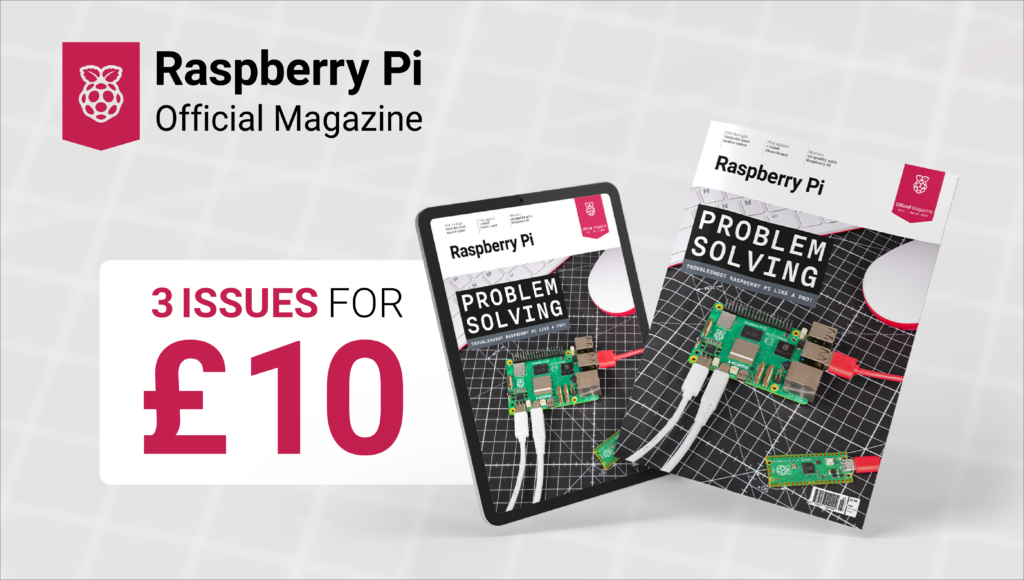
Otherwise, you can still grab the latest issue from our online store or the Raspberry Pi Store in Cambridge, and in WHSmith, Tesco, Sainsbury’s, Asda, and all good newsagents. Here’s a taster of what issue #151 has in store:
Raspberry Pi Chess Board
California high school student Tamerlan Goglichidze has been coding and building projects since he was 11, teaching himself essential skills using online videos and tutorials before progressing from virtual to physical creations once his knowledge base gave him the confidence. This early focus would be impressive enough in itself, but Tamerlan was also busy taking on all-comers as a chess player who travelled extensively to compete in International Chess Federation matches. His Raspberry Pi Chess Board combines the two interests.

Winning strategy
He chose Raspberry Pi 4 as “the brain of the system, bridging the digital chess world with physical movements on the board”, noting its ability to handle advanced and complex systems as well as the versatile OS and accessible GPIO pins. Tamerlan felt it “was the best choice to handle both the chess engine calculations and stepper motor movements.”
His Raspberry Pi Chess Board project built on his experience of creating a Raspberry Pi–based MARS rover with a robot arm and a small JARVIS (from Iron Man) mechatronic simulation with animatronic servo eyes that move around, and also integrated voice recognition and artificial intelligence.

Pure magnetism
Seeing DIY but expensive automated chess boards online motivated Tamerlan to create a functional, budget-friendly version with similar capabilities that would capitalise on his growing engineering skills. He designed most aspects using Fusion 360 and used a standard chess board, cutting wooden boards as a base in his parents’ garage.
Challenges for the automated chess system included accurately weighing each chess piece so the XY stepper motor mechanism and magnets could seamlessly move them across the board. Tamerlan tracked down an algorithm to minimise the stepper motor’s power consumption. He used a servo linear actuator with a magnet to move each chess piece, rather than an electromagnet, having calculated it would be more power-efficient. “To generate a strong enough magnetic field to lift or attract objects, high current is typically required, demanding a robust power supply and generating heat, which must be managed,” he explains. “In contrast, a servo linear actuator needs power primarily during movement, with significantly lower standby power consumption.”

Using magnets moved by a stepper motor rather than a robot arm allowed Tamerlan to make the chess board as compact as possible. He wrote Python code to control each piece, translating the coordinates for each of the board’s 64 squares into steps the stepper motor could execute. Raspberry Pi calculates the best moves according to player input and translates text such as ‘b3b5’ into moves. “Castling is straightforward and can be handled by writing two different functions to cover the four possible cases and executing them accordingly.” He also needed a way to move pieces without pushing others out of the way, in particular the knight’s dog-leg movements. His solution has the knight do a half-step between squares, follow its move, and then reverse the half-step.
Peer approval
Players can specify difficulty levels and whether to play as black or white pieces against the computer chess engine, and there is a web option for remote play against other chess fans. The project quickly garnered interest and plaudits online. Buoyed up by the success of his Raspberry Pi Chess Board, which “gained remarkable attention” and, after being featured by a number of tech hobbyist sites, led to 40,000 visits to his own website, Tamerlan has set his sights on a computing or engineering career.
Raspberry Pi Official Magazine #151 out NOW!

Buy your copy of Raspberry Pi Official Magazine now from our online store, subscribe, or grab one from any of the shops I mentioned above, and let us know what you think of our new look!

13 comments
Conrad Magallon
When will mag be available in the US
Raspberry Pi Staff Rob Zwetsloot — post author
Subscribers should have their copy soon, otherwise it may take another week to show up in stores
Jack
Is there a plan to update the Bookshelf app, to include the new magazine? Thanks in advance.
Raspberry Pi Staff Rob Zwetsloot — post author
It should be updated but you might need to do a software update of Raspberry Pi OS
Parker
Dang, I’ll be honest… going from a clever name like “MagPi” to just a generic description of “Raspberry Pi Official Magazine” is pretty uninspired. I would’ve just made that the secondary/sub-title and retained the former as the primary title for market goodwill
MarkWP
I agree entirely with you, Parker! The new design is dull, drab and dreary, and RPOM slips off the tongue like gravel. It’s an uninspiring and uninspired title that does not reflect the “shiny” attractions of the products, which tempt tinkerers everywhere like magpies.
Grug
Looks like a dry instruction manual.
BokFive
Perfect 🏆
Richard
“don’t fix it if it is not broke”. What a foolish decision to change the long used and distinctive name, Mag Pi, to an unimaginative name, Raspberry Pi official magazine. Sounds like big corporation non-think has taken over and we can expect this change to herald more impersonal and stagnant decisions in the future from Raspberry Pi.
BTW, when is Raspberry Pi going to update the seriously outdated Raspberry Pi Desktop? Very non-functional now with previous version of Raspberry PI OS (bullseye), no Wayland, no 64 bits, repository does not even work properly now. To think there is no money in updating the RPi Desktop for X86 and Mac compared to selling Rpi’s is a very short sighted view. Many people have been convinced to buy additional (or first time user) Raspberry Pi’s that could interface with the same desktop and largely the same software that would run on PC’s and Mac’s, to say nothing of giving a new life (and speed) to legacy computers that are no longer supported by newer Windows versions, and were formerly useless until they got the Rpi Desktop.
——————————————– (from the Rpi website)
Debian Bullseye with Raspberry Pi Desktop
Release date: July 1st 2022 (Almost 3 years now since an update!! 32 months!!!! Come on management, allocate sufficient resources to get this project done in time with the next Raspberry Pi OS release, and watch your sales soar.)
System: 32-bit
Kernel version: 5.10
Debian version: 11 (bullseye)
christoff S
Agreed. Dull looking. The Magpi had a unique, distinctive, fun layout and character, thanks in large part to Sam Alders art. I’ll reserve full judgment till I read it.
Richard Moss
Good luck with the rebrand, although I took think “magpi” was a stellar name.
(Plus I haven’t forgiven you for discontinuing wireframe)
script
I think it would be nice if they ensured that any person featured in an article gets the issue with that article.
Jackie Rogers
This is a bad decision. Stop removing the whimsy of raspberry pi.
Comments are closed